

Australia’s fintech industry is a dynamic, rapidly growing sector, which occupies a critical position in the nation’s A$10 trillion financial services market. According to IMARC, the value of Australia fintech Market size is 4.10 billion in 2024, the market is projected to reach USD 9.50 billion by 2033, reflecting a Compound Annual Growth Rate (CAGR) of 8.90% between 2025 and 2033
Below are key strengths of Australian fintech:
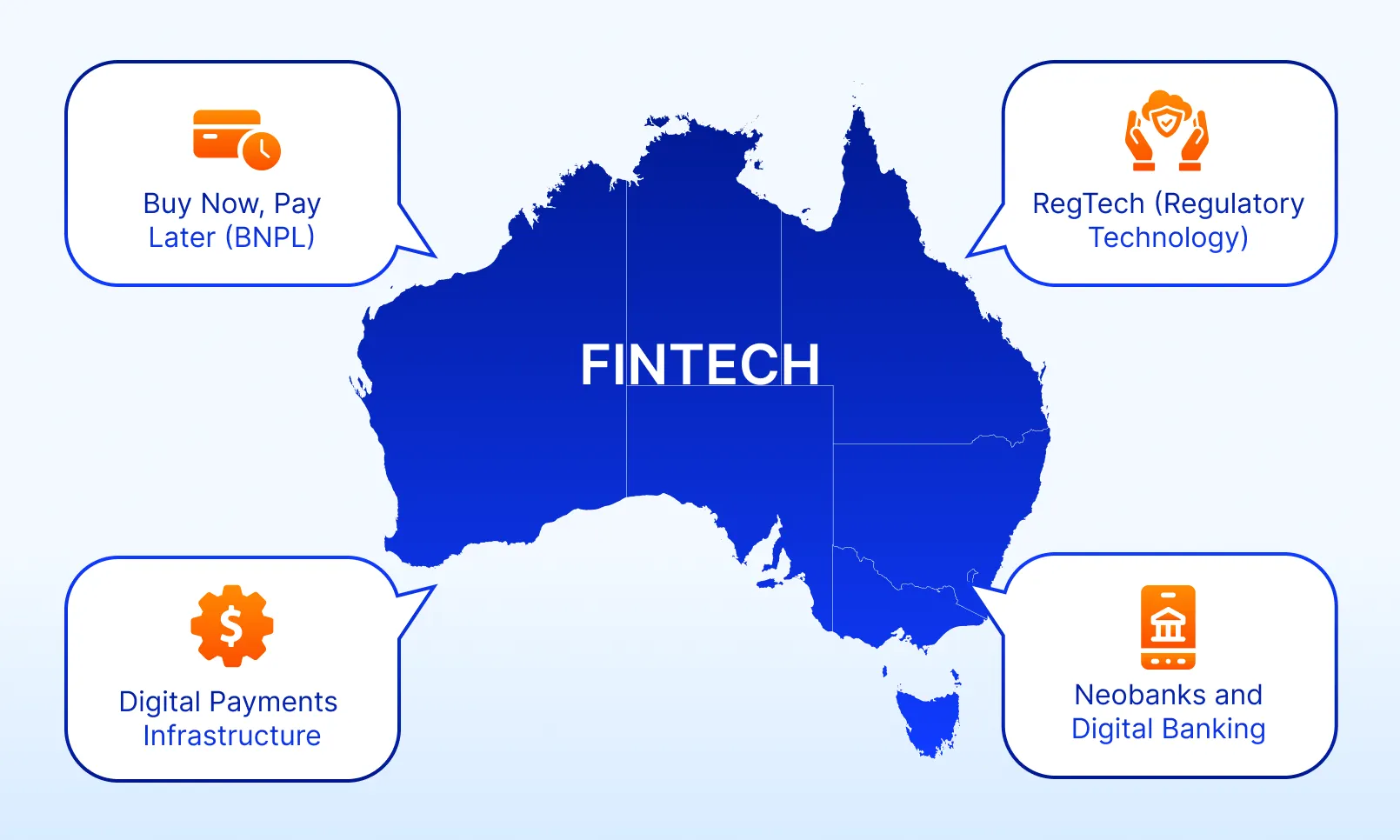
- Digital Payments Infrastructure: This is the core pillar that shapes the landscape, with high adoption of digital and contactless payments, with the growth in the New Payments Platform (NPP) for instant transfers.
- Buy Now, Pay Later (BNPL): Services, like Afterpay, have significantly attracted more users and changed consumer expenditure habits.
- RegTech (Regulatory Technology): Because of stringent financial regulations, Australian fintech companies are increasing investment in AI and Machine Learning (ML) tools to automate compliance, fraud detection, and risk management.
- Neobanks and Digital Banking: Many Australians prefer digital banking interactions, which lead to a rise in digital-native banks and a decline in physical branch usage.
This growing ecosystem, supported by a tech-savvy population and government initiatives like the Consumer Data Right (CDR) for Open Banking, makes Australia an ideal testing ground for next-generation financial technology. Along with the growth of AI, the fintech business owners are focusing on AI-related features to make their app more competitive.
Benefits of AI agents in Fintech for Australian Consumers
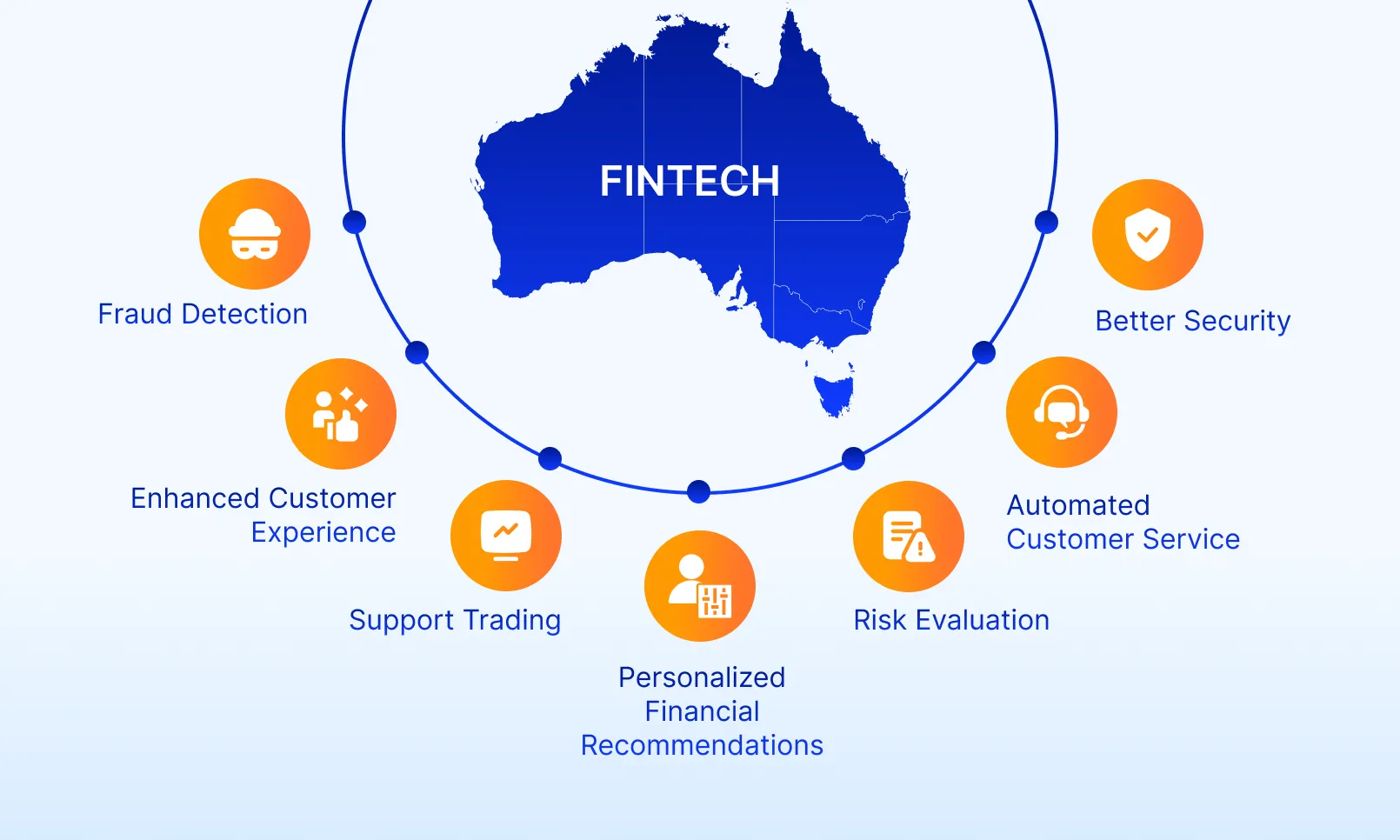
Artificial Intelligence (AI) is fundamentally transforming financial services by delivering faster, more secure, and highly personalised experiences for Australian consumers. For instance, it brings a lot of benefits such as fraud detection, user experience improvement, trading support, financial recommendations, risk evaluation, customer service automation and security enhancement. Let’s explore more detail about these benefits as below.
1. Fraud Detection
AI and ML algorithms analyse millions of transactions in real-time, identifying anomalous patterns that traditional systems often miss. This constant learning helps in:
- Proactive Defense: It detects sophisticated scams like synthetic ID fraud and money laundering schemes instantly.
- Reduced False Positives: It minimizes the number of legitimate transactions incorrectly flagged and improve the customer experience. For example, some Australian banks’ AI systems analyze millions of daily payments to send thousands of proactive scam alerts, which significantly reduces customer scam losses.
2. Enhanced Customer Experience
AI-powered tools are transforming customer service in financial companies by enabling 24/7 support, faster response times, and efficient operation processes.
- Intelligent Chatbots and Virtual Assistants: They can utilise Natural Language Processing (NLP) to understand customer intent, answer queries instantly, and automate over 200 banking tasks, significantly reducing call-centre wait times.
- Smoother Onboarding: Automating Know Your Customer (KYC) and identity verification use AI and Computer Vision to speed up as well as ensure the accuracy of customer sign-ups.
3. Support Trading
For investors, AI has become a powerful analytical tool for wealth management capabilities:
- High-Frequency Trading: With the support of AI agents, this feature can execute trades at speeds and volumes that are impossible for humans. This greatly helps in capturing market opportunities.
- Market Analysis: Market research tools now can analyse vast datasets, market news, and economic indicators in real-time to inform and automatically adjust investment strategies.
4. Personalized Financial Recommendations
AI is shifting financial advice from generic recommendations to specific and personalised guidance:
- Personalised Advice: AI has strong power to analyse individual spending, saving habits, risk tolerance, and financial goals to provide customised product recommendations, optimal insurance plans, and investment portfolio adjustments.
- Robo-Advisors: AI-powered Robo-Advisors offer automated, low-cost investment management, which make in-depth financial advices accessible to a wider Australian.
5. Risk Evaluation
AI is reshaping how Australian fintech companies assess risk, particularly in lending decisions:
- Smarter Credit Scoring: ML models incorporate a big range of data (like utility payments or non-traditional financial behaviours) beyond standard credit history, then offer a more comprehensive view of a borrower’s financial health.
- Financial Inclusion: With the support of AI agents, fintech firms can enable faster, fairer, and more inclusive lending decisions, particularly benefiting underserved populations and individuals with limited credit history
6. Automated Customer Service
From intelligently routing complex issues to enabling self-service through virtual assistants, AI enhances efficiency, reduces costs, and improves the overall customer experience.
- Intelligent Routing: AI agent helps direct complex customer issues to the right human agent with all the necessary context from previous AI interactions.
- Self-Service Resolution: Customers can complete complicated tasks such as account management or dispute resolution entirely through a virtual assistant interface.
7. Better Security
AI is transforming cybersecurity capabilities with 2 outstanding features as below
- Behavioral Biometrics: Fintech platform now can monitor user behaviour (typing speed, mouse movements) and instantly identify and flag suspicious access patterns that may indicate a breached
- Threat Intelligence: It also learns from global financial crime data to pre-empt new types of cyberattacks and constantly harden security protocols.
Use Cases of AI in the Fintech Industry
You can see the practical applications of AI span every side of the financial services. Below are some common use cases where we can apply AI for cost and time saving.
| Use Case | Description & Australian Example |
| Automated Underwriting & Lending | AI will instantly assess home loan applications by analysing risk profiles, which helps speed up decisions and reduce manual effort. Example: Tiimely’s real-time AI home loan platform, which automates the financial assessment and credit decisioning process for lenders |
| KYC/AML Monitoring | AI agents automate anti-money laundering (AML) and Know Your Customer (KYC) checks. Futhermore, it monitors transactions for suspicious activities and generates audit trails for compliance. Example: Up Bank’s Intelligent Document Processing for new user account creation. |
| Conversational AI Agents | End-to-end customer service agents that handle queries, process transactions, and offer proactive help. Example: Commonwealth Bank’s ‘Ceba’ virtual assistant, which automates hundreds of banking tasks. |
| Portfolio Rebalancing | AI-integrated platforms automatically adjust investment portfolios based on market shifts and individual’s goals, which ensure optimal profits with minimal human intervention. Example: Raiz Invest utilises AI for wealth optimisation. |
| Treasury & Liquidity Management | AI combines bank feeds and Enterprise Resource Planning (ERP) data to provide continuous liquidity intelligence and test thousands of financial scenarios for accurate forecasting. Example: ANZ Bank’s use of AI for treasury forecasting. |
| Insurance Claims Automation | AI, sometimes using Computer Vision, automates the processing and verification of insurance claims for speeding up payouts and detecting fraud. |
How to build AI Agents in Fintech App
If you want to develop a successful AI Agent, whether an advanced robo-advisor or a simple chatbot, it requires a structured, data-centric approach. Below are 5 main steps that you can consider.
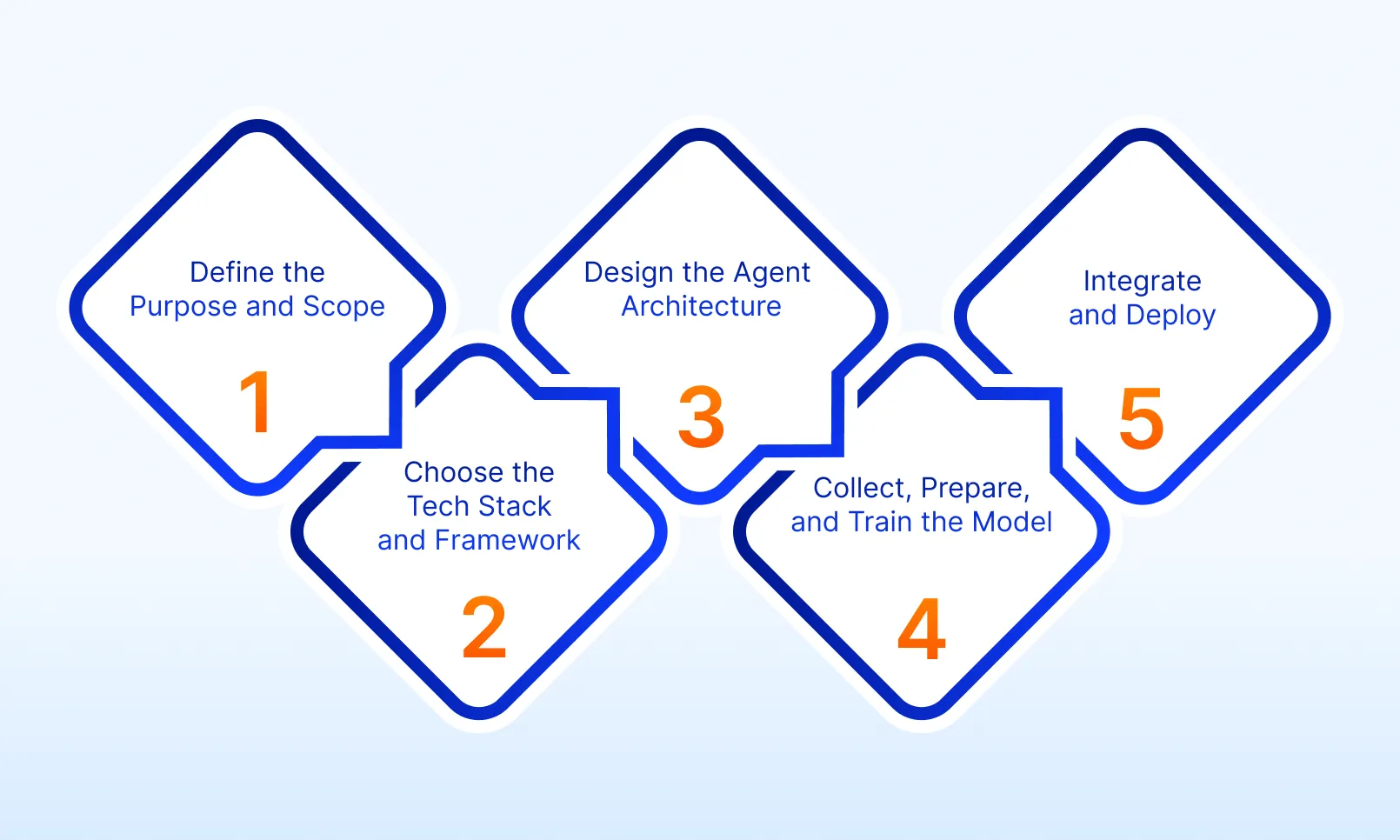
1. Define the Purpose and Scope
A successful AI agent initiative begins with a clear understanding of its purpose. Business problem and the agent’s role determination will ensure the solution delivers desired value and aligns with organisational objectives.
- Identify the Problem: Start by clearly defining the specific, high-value problem the agent will solve (e.g., reducing credit application processing time by 50%).
- Define User Interaction: Determine the agent’s role (e.g., customer support, middle office automation, compliance focus).
2. Choose the Tech Stack and Framework
The right technology stack is important to building a scalable and secure AI agent. The chosen programming languages, frameworks, and cloud platforms should support performance, integration flexibility, and long-term maintainability.
- Programming Language: Python is the industry standard due to its strong library foundation.
- AI/ML Frameworks: TensorFlow or PyTorch will provide high performance and long-term stability for core model development.
- Agent Frameworks: LangChain or Semantic Kernel helps integrate large language models (LLMs) and tools, or Rasa for open-source conversational AI.
- Cloud Platform: With the scalable ability, AWS, Google Cloud Platform (GCP), or Azure are considered for hosting and computational power
3. Design the Agent Architecture
A well-designed agent architecture enables efficiently data flow, scalability, and reliable decision-making. So, every effective AI agent must have modular components to ensure data flow and scalability:
- Perception Module: Gathers inputs (user query, transaction data, market API feeds).
- Decision-Making Module: The core logic that interprets the data, accesses memory/tools, and determines the best course of action.
- Action Module: Executes the final task (sends a reply, updates a database, triggers a payment).
4. Collect, Prepare, and Train the Model
High quality data and well-structure training processes are the foundation of an effective AI agent. Careful data preparation, model selection, and evaluation helps ensure accuracy, reliability, and compliance, especially in regulated environments such as Australian fintech market.
- Data Foundation: Collect high-quality, relevant data (historical transactions, customer service logs, financial documents). For Australian fintech companies, data security and compliance with Australian privacy laws (APPs) are a must.
- Model Training: Train your chosen ML model (Supervised Learning for classification, Reinforcement Learning for complex decision-making) on the prepared data.
- Evaluation: Rigorously test the model’s accuracy, reliability, and security against a separate test dataset.
5. Integrate and Deploy
A successful deployment of the AI agent requires continuous integration with existing systems and reliable cloud infrastructure. Besides, real-time monitoring ensures the AI agent performs consistently at scale while meeting operational and regulatory expectations.
- API Integration: Connect the agent’s backend to your app’s frontend and critical third-party systems (CRM, core banking system) using secure APIs.
- Deployment: Deploy the agent to your cloud infrastructure and ensure that it can scale with increasing user loads.
- Monitoring: Implement continuous monitoring to track performance metrics, gather user feedback, and quickly identify and correct errors or undesirable outputs.
Future of AI in Australian Fintech Industry
The evolution of AI in Australian fintech businesses is one of deepening integration, regulatory evolution, and transformative economic impact to the country
- Economic Impact and Investment: According to Artificial Intelligence Report by CSIRO’s Data61, AI is expected to contribute a significant portion of the A$315 billion in economic growth predicted from digital technologies in Australia by 2028. Investment in AI technologies within the financial sector is expected to grow substantially, reflecting a strong appetite for innovation.
- Generative AI (GenAI) for Hyper-Personalisation: GenAI will move beyond chatbots to create complex financial documents, detailed portfolio summaries, and highly engaging user journeys that feel like premium human service. Therefore, ANZ-NZ businesses are already planning to invest more in GenAI than the global average, based on data from Cognizant
- Predictive Regulation (RegTech 2.0): AI will become essential for real-time compliance. Future RegTech solutions will use predictive analytics to anticipate regulatory breaches before they occur, automatically adjusting internal controls in response to global regulatory changes.
- Focus on Trust: As AI becomes popular, Australian consumers are showing increasing caution regarding the use of AI and data. This will drive a focus on responsible AI frameworks that prioritise transparency, explainability, fairness, and consumer consent to build trust.
- AI-Blockchain Combination: The integration of AI with blockchain technology will further enhance transaction security, increase transparency, and improve cross-border payments, which makes the Australian financial system more resilient and efficient.
Conclusion
The collaboration between Fintech and AI is not only an optional upgrade in Australia; it is the key feature of its financial future. From instantaneous fraud detection to personalised wealth advice and simplified regulatory compliance, AI is delivering benefits for both businesses and consumers. By embracing the steps for building AI Agents, Australian fintech is well-positioned to consolidate its status as a global leader in innovative, security, and customer-focused financial services.
At LARION, we provide fintech and banking application development services for the Australian market, with success stories such as SurroundCore Banking Solutions (ANZ) and International Money Transfer Platform (Eastern & Allied). Therefore, if you are looking for fintech solutions that comply with Australia’s regulatory and market landscape, we are always ready to partner with you.