AI transformation in financial services is not a sequence of model demonstrations. It is a program for changing business decisions and workflows with approved data, accountable owners, testable controls, and evidence that the result is worth operating.
A bank can run an impressive generative AI pilot and still have no safe way to use it with customer records. A fintech can automate a manual step and still create more exception handling than it eliminates. The challenge is connecting an AI opportunity to the financial workflow it changes, then deciding whether it should move into production.
This guide offers an actionable fintech AI transformation roadmap that also works as a planning framework for banks and other financial institutions. It follows five decision stages: define the outcome, establish readiness, prioritize opportunities, validate through controlled delivery, and operate with continuous oversight. At each stage, leaders should be able to say Go, Hold, or Stop based on evidence not enthusiasm.
The urgency is real, but it should not replace judgment. In the Bank of England and FCA’s October 2026 survey, 86% of responding UK financial firms reported using AI. The same survey found third-party implementations accounted for 53% of systems respondents classified as high materiality. These are UK respondent findings, not estimates of US market adoption; they illustrate why production accountability and supplier oversight deserve attention alongside experimentation. Source: Bank of England/FCA, 2026.
Key takeaways
- Start with a business decision, not a model. Name the workflow, the baseline, the owner, and the outcome that must improve.
- Treat readiness as evidence. Data permissions, workflow exceptions, security, integration, and operational ownership must be demonstrable, not assumed.
- Prioritize by benefit, feasibility, and consequence of failure. A high-value idea with unresolved data rights or unacceptable customer impact is not pilot-ready.
- Use stage gates to prevent pilot sprawl. A proof of value tests the hypothesis; a pilot tests the real workflow; production approval requires operational evidence.
- Measure the full system. Track accepted outcomes, exception rates, human review, operating costs, model behavior, and customer impact after launch.
Define what AI transformation means for the institution
An AI strategy is useful when it changes resource allocation and operating decisions. A list of use cases, tools, or innovation themes is not yet a transformation roadmap.
Operational efficiency versus product innovation
Financial institutions generally pursue two overlapping goals. The first is to improve an existing process: reduce manual review time, help analysts locate relevant policies, or surface suspicious transactions sooner. The second is to change a product or service: deliver a new customer interaction, improve decision support, or create a capability the institution could not previously offer.
These objectives need different evidence. For an internal document assistant, a plausible outcome is reduced time to resolve an eligible inquiry while preserving answer quality and access controls. For a customer-facing lending workflow, speed alone is insufficient; decision quality, customer fairness, reviewability, and downstream consequences must also be addressed.
Write a one-sentence outcome charter:
For [defined users] performing [specific workflow], we will improve [measurable outcome] from [verified baseline], without breaching [risk and service constraints]. [named owner] decides whether to deploy.
If the baseline is unknown, the next deliverable is instrumentation not a business case claiming savings.
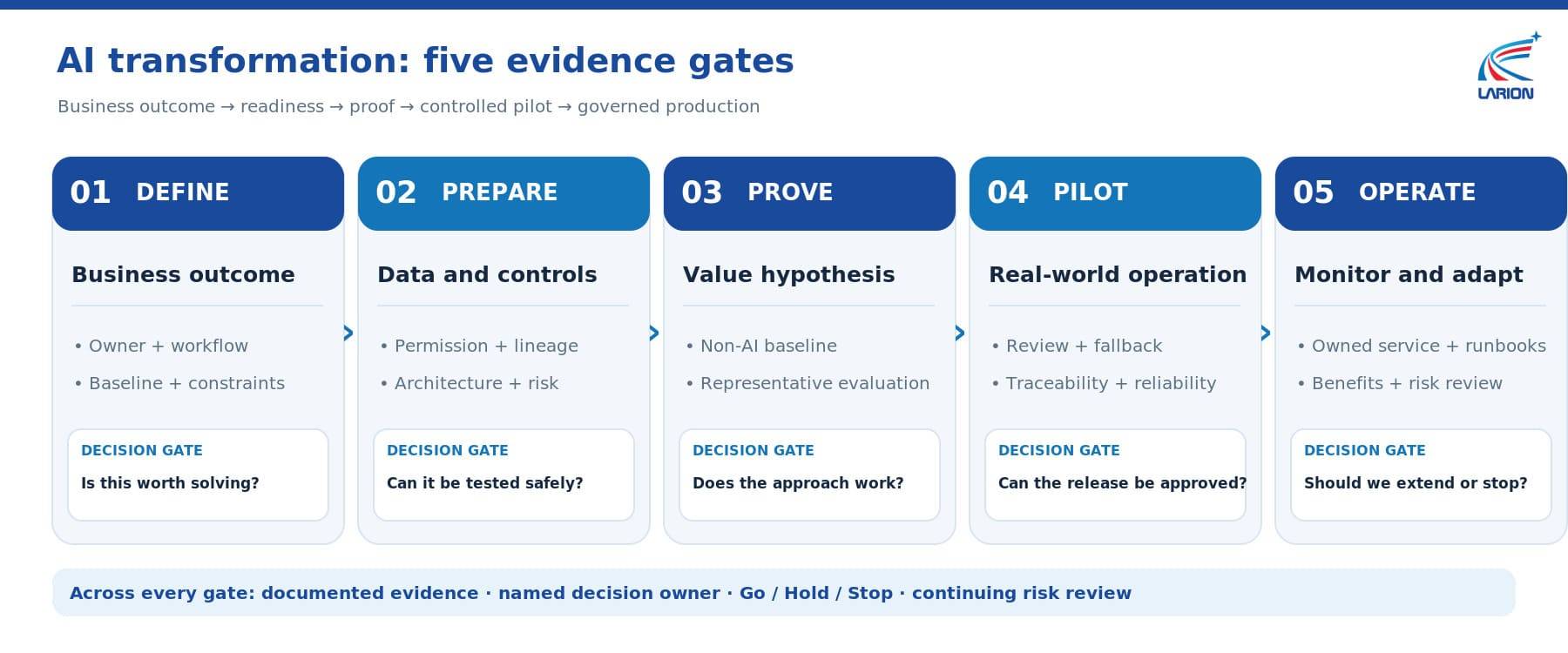
AI transformation financial services – Five stage roadmap
AI strategy versus isolated experiments
Experimentation asks, “Can this model perform a task?” Transformation asks, “Should this workflow change, who will run the new version, and how will we know it is better?”
A useful portfolio has three lanes: improve an existing process with an accountable owner; enable a reusable capability such as authorized knowledge retrieval or secure document processing; and explore a consequential opportunity under a strictly limited research mandate. The lanes are editorial planning categories, not regulatory risk classifications.
Make four decisions before committing significant delivery capacity: Which outcomes have executive sponsorship? Which opportunities share data or integration dependencies? Which controls are mandatory before live use? Which initiatives will be stopped if evidence fails?
The World Economic Forum’s 2026 AI Playbook for Financial Services similarly emphasizes strategy, governance, data, workforce readiness, and scaled deployment. Its guidance is a useful external reference, rather than a substitute for an institution-specific operating model. Source: World Economic Forum, 2026.
Establish enterprise AI readiness
Readiness should be established for the specific workflow and its impact, rather than reduced to an enterprise maturity score. A bank may be ready to test an internal policy assistant but not ready to let an autonomous system change a payment instruction.
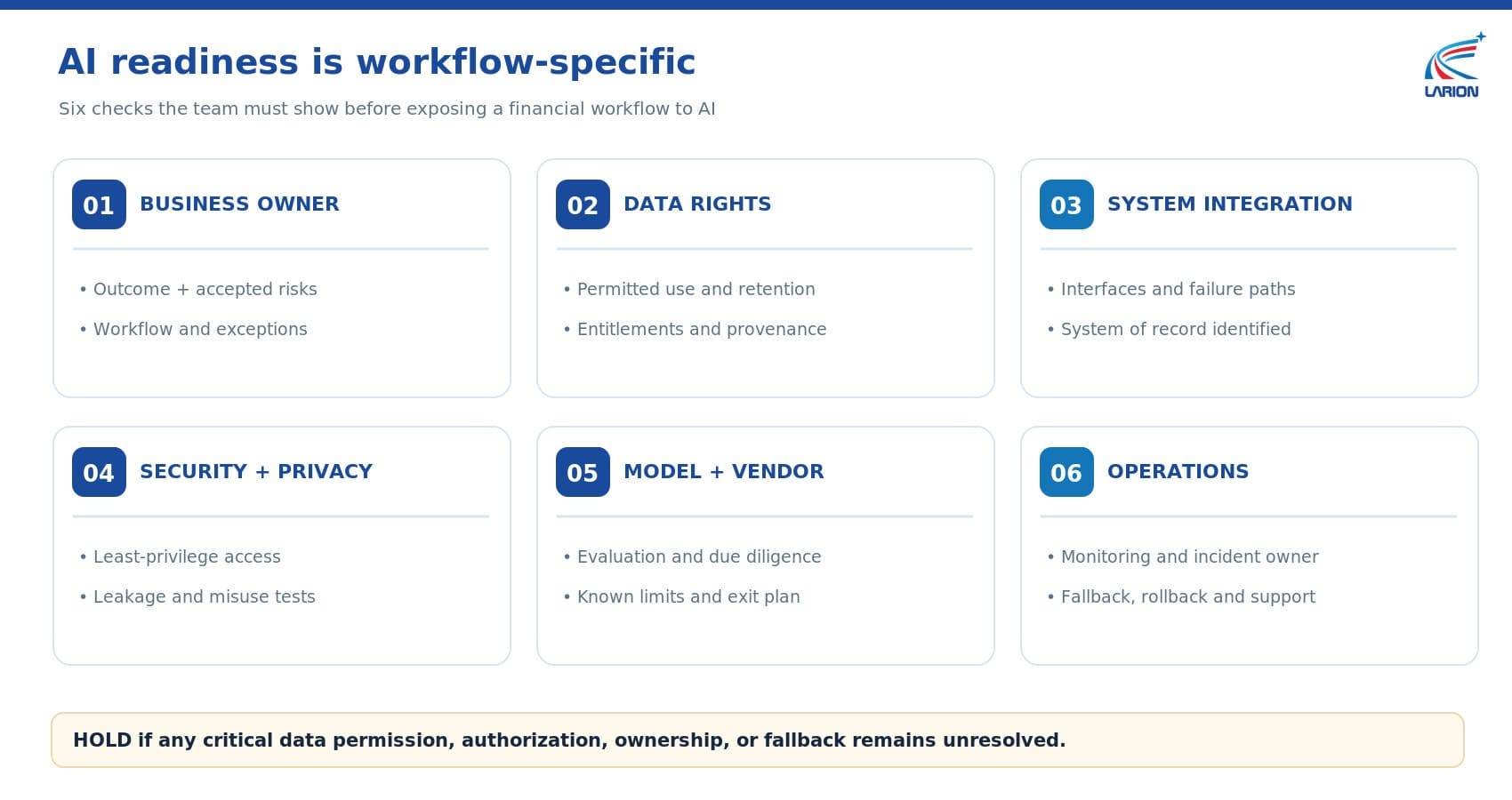
AI transformation financial services – Readiness control map
Data availability and sensitive information
For each candidate, record the system of record, data owner, update frequency, sensitivity, retention policy, permitted use, and applicable user entitlements. Verify whether the data can legally and contractually be processed by the proposed technology and its providers.
A document corpus is not “AI-ready” simply because it can be indexed. Check whether records are current, conflicting versions are resolved, access permissions survive retrieval, and evidence can be traced to the original source. For transactional systems, add data quality, reconciliation, latency, and failure recovery requirements.
Evidence to request: a data-flow diagram, sample records cleared for testing, access-control tests, retention requirements, documented data lineage, and an inventory of known gaps.
Operating model and accountable stakeholders
Every initiative needs an accountable business owner, a technical service owner, and defined risk/control reviewers. The business owner accepts workflow outcomes; engineering owns reliable implementation; security, legal, compliance, privacy, and model-risk functions perform reviews appropriate to the use case. Independent challenge and approval should not be silently delegated to the vendor building the system.
A lean accountability map is enough to begin:
| Decision | Typical accountable party | Required evidence |
|---|---|---|
| Is the problem worth solving? | Business/process owner | Baseline, expected outcome, affected users |
| Can these data be used? | Data owner with privacy/legal input | Data rights, classification, access and retention rules |
| Is the solution technically supportable? | Engineering/service owner | Architecture, integration, reliability and recovery evidence |
| Is the risk acceptable? | Authorized risk/control decision-maker | Risk assessment, tests, unresolved limitations |
| May the workflow go live? | Designated release authority | Signed acceptance, runbooks, monitoring and rollback |
Actual approval titles and separation of duties depend on the institution and applicable rules. A committee name is not a control by itself.
Security, model and third-party governance
Apply governance across the entire delivery chain: data, prompts, retrieval, models, tools, people, and production operations. Inventory model/API providers, cloud hosts, data processors, subcontractors, and the consequences of an outage or supplier change. Test least-privilege access, prompt-injection exposure, leakage paths, logging, response handling, and recovery procedures where relevant.
For US banking organizations, distinguish the rules that truly apply. The US banking agencies’ April 2026 revised model risk management guidance (SR 26-2) superseded SR 11-7 and emphasizes risk-proportionate practices. Its definition of models does not include generative or agentic AI, although the guidance says an institution’s broader governance practices should inform controls for tools outside that scope. Do not cite the old SR 11-7 as if it remains the current standalone standard for all AI. Source: Federal Reserve, SR 26-2.
For GenAI-specific risk management, the voluntary NIST AI RMF and its Generative AI Profile provide a useful structure: Govern, Map, Measure, and Manage. These are interconnected risk-management functions, not a prescribed project sequence or a legal compliance certificate. Source: NIST AI RMF Core and NIST Generative AI Profile.
Where banks rely on third parties, the 2023 US interagency guidance describes a lifecycle including planning, due diligence, contracting, ongoing monitoring, and termination, calibrated to relationship criticality. The obligations relevant to a particular bank, fintech, and activity still require legal and compliance review. Source: OCC interagency guidance.
Readiness gate: Hold if no one can authorize data use, a sensitive workflow lacks an owner, access controls cannot be tested, or an essential vendor dependency has no feasible operating fallback.
Prioritize and sequence AI investments
The best first use case is not necessarily the one with the largest theoretical revenue or the most impressive model. It is an opportunity with a meaningful outcome, a credible path to delivery, and risks the institution can control.
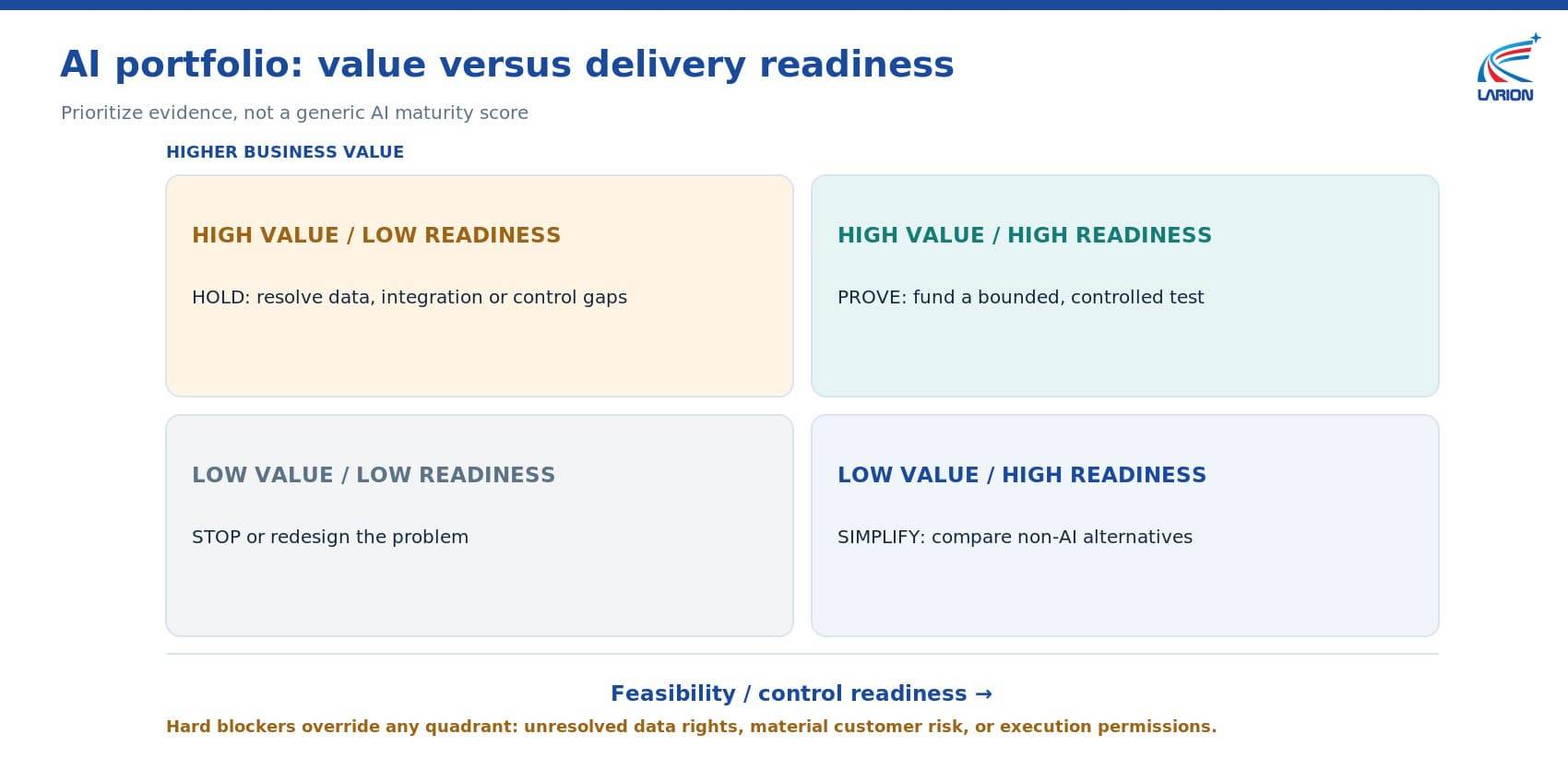
AI transformation financial services – Usecase prioritization matrix
Business outcomes and value hypotheses
Write a hypothesis that can be disproved. For example: “Providing analysts with access-controlled summaries of approved procedures will reduce median handling time for eligible cases without increasing incorrect responses or escalations.” Define the eligible population and comparison method before testing.
Separate three types of measures:
- Outcome: time to resolution, eligible cases completed, customer friction, fraud-loss exposure, or other business impact.
- Quality and risk: unsupported answers, false positives/negatives, security events, fairness issues, and human overrides.
- Economics: implementation and operating costs, review effort, retraining, vendor charges, and benefits that can actually be realized.
A basic net-value hypothesis is realized incremental benefit − incremental build and operating cost − attributable adverse impact. Avoid treating released staff time automatically as a cash saving. A detailed attribution model belongs in a separate financial ROI analysis.
Feasibility, materiality and risk assessment
First screen out hard blockers. Then compare candidates along value, data/process readiness, integration complexity, materiality/customer impact, and reversibility. Avoid summing arbitrary weighted scores into a single “scientific” ranking unless the weights and calibration have actually been validated.
| Decision category | What to verify | Implication |
|---|---|---|
| High value, demonstrable controls, reversible | Baseline, available data, owner and rollback path | Candidate for controlled proof of value |
| High value, missing permissions or integration | Data rights, dependencies or control ownership unresolved | Hold and fund targeted readiness work |
| High potential harm, irreversible execution | Customer/financial effect, independent review, autonomy boundary | Narrow to advisory mode or redesign; do not advance by ROI alone |
| Low value, high recurring effort | Implementation and ongoing operating burden | Stop, simplify, or choose a non-AI alternative |
Before choosing an LLM, ask whether deterministic rules, standard analytics, conventional ML, a configured platform, or a process change would solve the problem more reliably. “No AI” is a legitimate outcome of prioritization.
Portfolio gate: Advance only candidates with a named outcome owner, a feasible technical path, an explicit control boundary, and a falsifiable benefit hypothesis. Defer candidates whose essential prerequisites are still unknown.
Move through implementation stages
A production roadmap should specify deliverables and decision rights rather than promising a universal 30-, 60-, or 90-day transformation. The five-stage sequence below is a proposed operating framework, not a regulator-mandated lifecycle.
| Stage | Required artifact | Gate question | Decision owner |
|---|---|---|---|
| 1. Outcome definition | Workflow charter and baseline plan | Is the business problem worth solving? | Business sponsor |
| 2. Readiness | Data/control map and architecture constraints | Can we test it appropriately? | Data, technical and risk owners |
| 3. Prioritization and proof of value | Shortlist, test design and PoV evidence | Does the approach work on representative tasks? | Product and technical owners |
| 4. Controlled pilot | Real-workflow evaluation and operating evidence | Is live deployment acceptable within defined limits? | Release authority with risk input |
| 5. Governed production | Monitoring, ownership and benefits review | Can we operate, improve and retire it safely? | Service and business owners |
Discovery and controlled proof of value
Start by mapping the actual workflow: inputs, human judgments, handoffs, failure modes, and exceptions. Identify what a useful output looks like and what would make an output unsafe. Establish the non-AI baseline and an evaluation dataset reflecting representative and difficult cases.
A proof of value should test more than model capability: source fidelity, entitlement behavior, integration feasibility, workflow fit, human review demand, and indicative unit economics. Use appropriately approved or synthetic data when live customer information is unnecessary or not authorized. Keep the trial separate from customer-impacting execution.
Go: evidence supports the hypothesis and the major deployment unknowns are bounded. Hold: gaps are addressable but not yet proven. Stop: a simpler solution works better or the risk-benefit case fails.
Pilot evaluation and production decision
A pilot is not a larger demo. It exposes the system to a defined operational population while maintaining scope, approvals, escalation paths, and an exit plan. Compare outcomes against a documented baseline, and inspect failure clusters rather than relying only on an average accuracy result.
Before granting production access, require evidence of access-control enforcement, source or transaction traceability, representative evaluation, exception handling, security review, on-call ownership, rollback capability, change control, and customer impact assessment where relevant.
For a customer-facing or decision-support model, document which decisions remain with humans. For tools that can execute actions, enforce authorization outside the model. A model’s confidence statement must not itself authorize a transaction, modify a customer’s record, or bypass segregation of duties.
Production gate: Approve a bounded release only when the designated authority accepts the residual risk and the team can operate, monitor, and revert the workflow. Otherwise hold, narrow the scope, or stop.
Scaled deployment and continuous monitoring
Scale repeatable capabilities, not merely the number of pilots. Reusable assets may include approved identity and entitlement patterns, secure retrieval, evaluation datasets, event logging, incident procedures, vendor-assurance records, and release templates. Each new workflow still needs its own impact and control assessment.
After release, monitor business value and system behavior together. Define thresholds for review, human fallback, suspension, and rollback; periodically retest after data, model, prompt, vendor, or policy changes. Confirm that benefits persist rather than assuming the pilot result survives changes in users and workload.
The Financial Stability Board identifies third-party concentration, cyber vulnerabilities, model risk, and data/governance weaknesses among financial-sector AI concerns. Those concerns reinforce the need for portfolio-level oversight beyond any single use case. Source: FSB, 2024.
Three illustrative financial AI workflows: what changes at each gate?
The scenarios below are hypothetical design illustrations, not LARION client case studies or published deployment results. They deliberately show the same decision logic applied to different levels of consequence.
Scenario 1: Internal policy assistant for bank operations
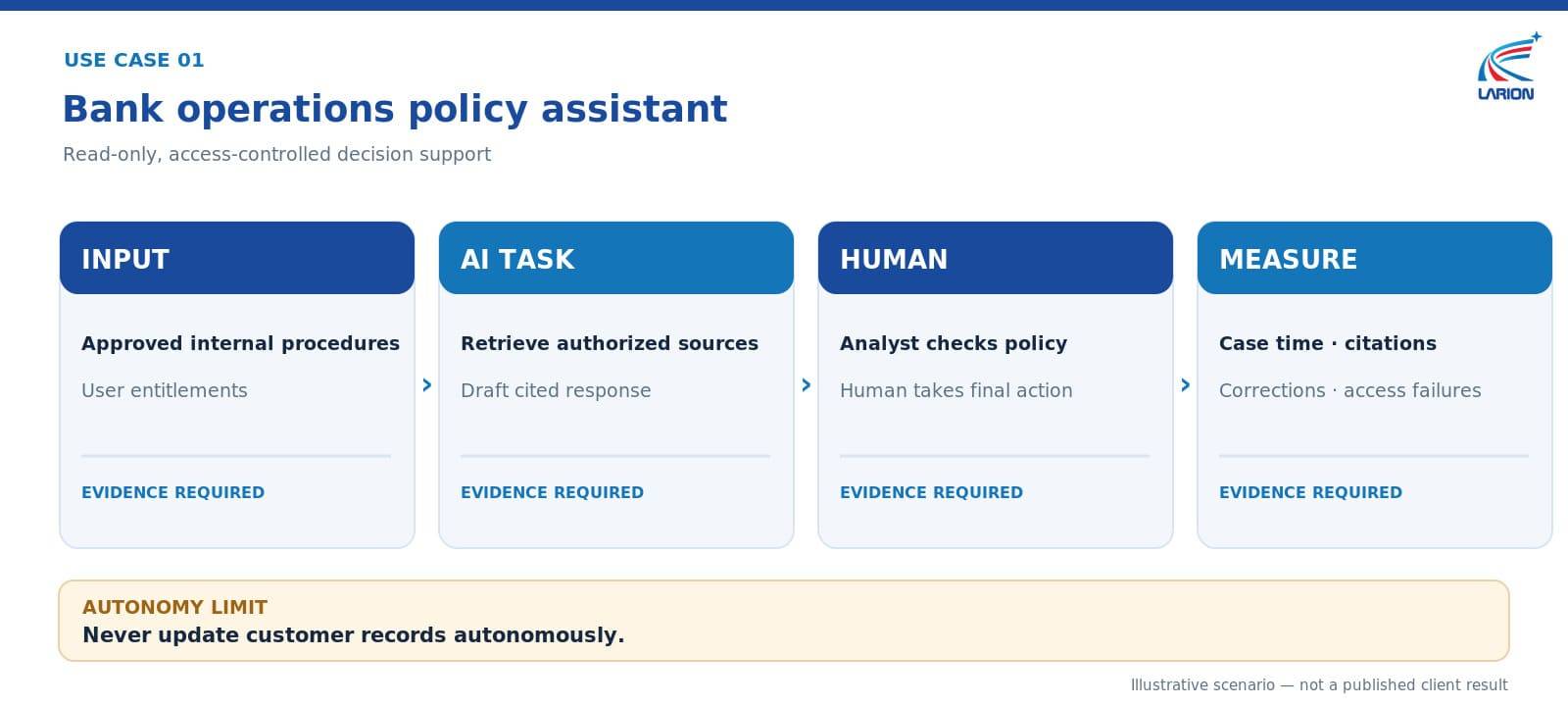
AI transformation financial services- Usecase policy assistant
Workflow: An operations analyst searches internal procedures before answering a case. Potential AI role: Retrieve authorized documents and draft a cited response, with the analyst responsible for the final action.
Evidence path: Confirm document owners and access rights; create test cases for outdated and conflicting policies; evaluate whether summaries cite the right version; pilot with a restricted analyst group. Operating signals: median eligible-case resolution time, citation fidelity, access-control failures, human correction rate, and escalation volume.
Boundary: No autonomous changes to customer records. If document entitlements cannot be enforced, hold the deployment regardless of answer fluency.
Scenario 2: Fraud alert triage assistance
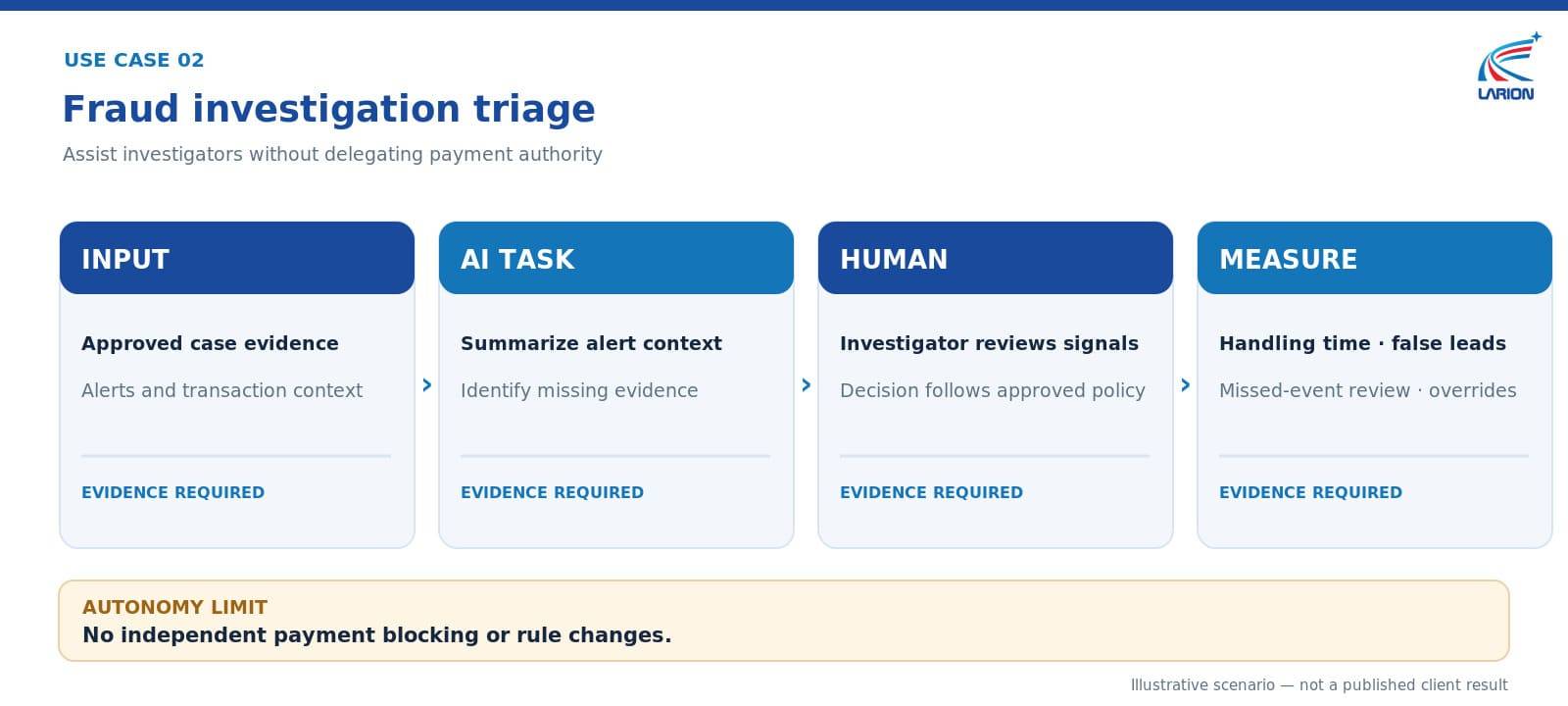
AI transformation financial services – Usecase fraud triage
Workflow: Investigators review potentially suspicious events. Potential AI role: Group relevant case evidence, summarize reasons for alerting, and recommend which evidence an investigator should inspect next.
Evidence path: Define the investigation decision and permissible data; test against historical, appropriately authorized cases; examine missed signals, false leads, and operational load; run a controlled shadow or assistive pilot. Operating signals: investigator handling time, false escalation volume, missed-event review, traceability, and override reasons.
Boundary: The system should not independently block payments or alter risk rules unless separately designed, authorized, validated, and governed for that action. A faster triage time does not compensate for unacceptable missed-event risk.
Scenario 3: Fintech onboarding-document review
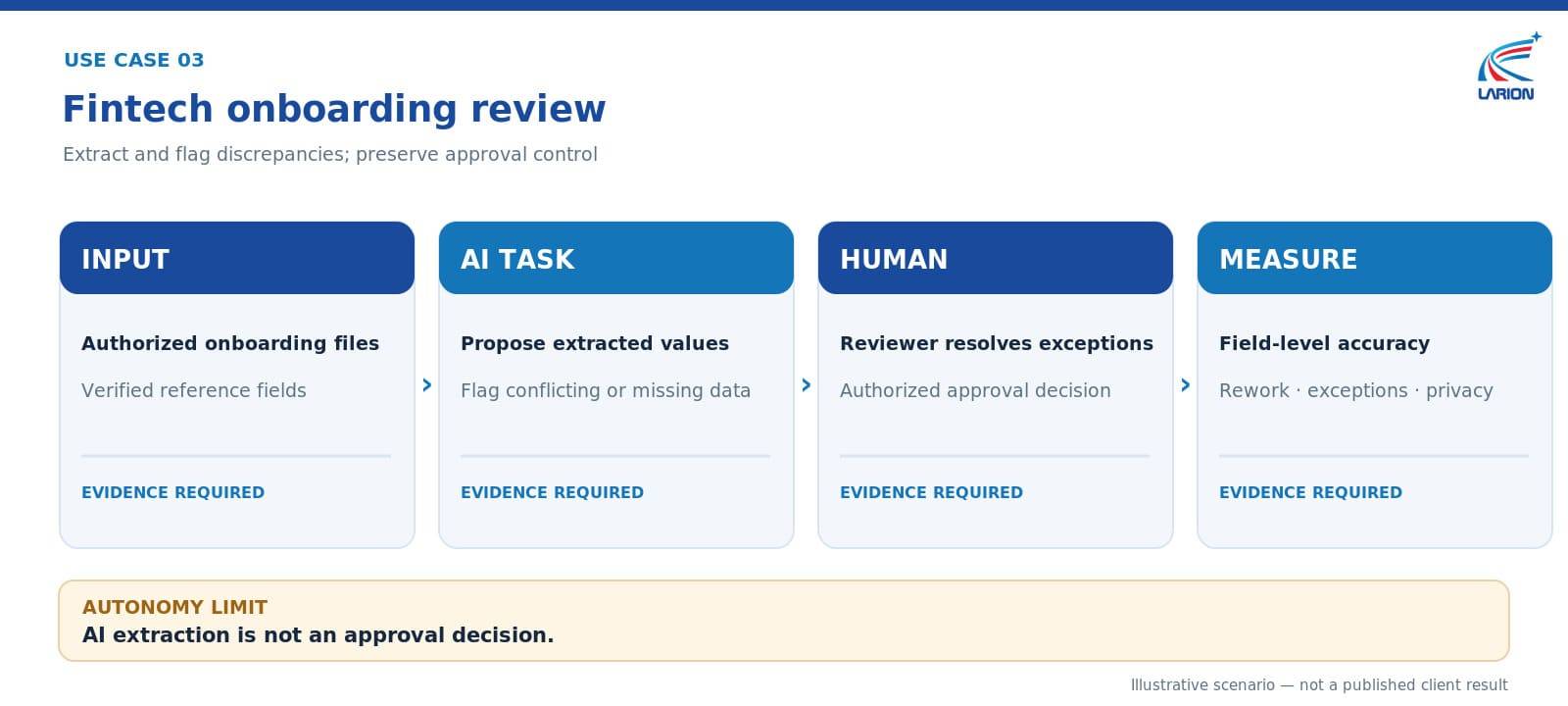
Workflow: An onboarding team extracts fields from identity or business records and reconciles them with submitted information. Potential AI role: Propose extracted values and flag missing or conflicting evidence for a human reviewer.
Evidence path: Establish permitted documents and retention rules; compare extraction with verified reference values; test low-quality scans, multiple languages where applicable, and ambiguous fields; pilot with controlled exception handling. Operating signals: accepted extraction accuracy by field, rework hours, exception rate, customer delays, and privacy/security incidents.
Boundary: Keep identity verification and approval responsibilities with authorized controls and people unless a specific automated decision has passed all applicable requirements.
The comparison: All three use cases may use AI, but their acceptable autonomy, error consequences, data permissions, and production evidence differ. That is why a generic use-case list is not a transformation roadmap.
Financial AI transformation scorecard and roadmap
Use a single scorecard per initiative to make the next decision visible. Record baseline, target or acceptance threshold, observed result, evidence source, owner, and decision. Targets must be set by the institution; the template below intentionally contains no invented performance figures.
| Dimension | Example metric or evidence | Frequency / decision trigger |
|---|---|---|
| Business result | Eligible cases completed; handling time; customer outcome | Baseline, pilot, and post-launch review |
| Quality | Supported-answer rate; field-level accuracy; missed-event review | Representative evaluation plus regression testing |
| Risk and security | Unauthorized access attempts; critical control failures; adverse customer effects | Pre-release blocker and live alerting |
| Human oversight | Override rate; unresolved exceptions; escalation time | Pilot and operating review |
| Operational reliability | Workflow success, latency, incident recovery, fallback performance | Pilot load testing and ongoing monitoring |
| Economics | Incremental costs and verified realizable benefits | Investment approval and periodic benefit review |
| Ownership | Named service owner, runbooks, supplier exit plan | Mandatory before production approval |
A workable roadmap decision record should fit on one page and answer: What workflow changes? What is the observed baseline? Why AI rather than a simpler alternative? Which data and third parties are involved? Who can approve each gate? Which risks are non-negotiable? What evidence would cause the team to stop? Who owns operation and eventual retirement?
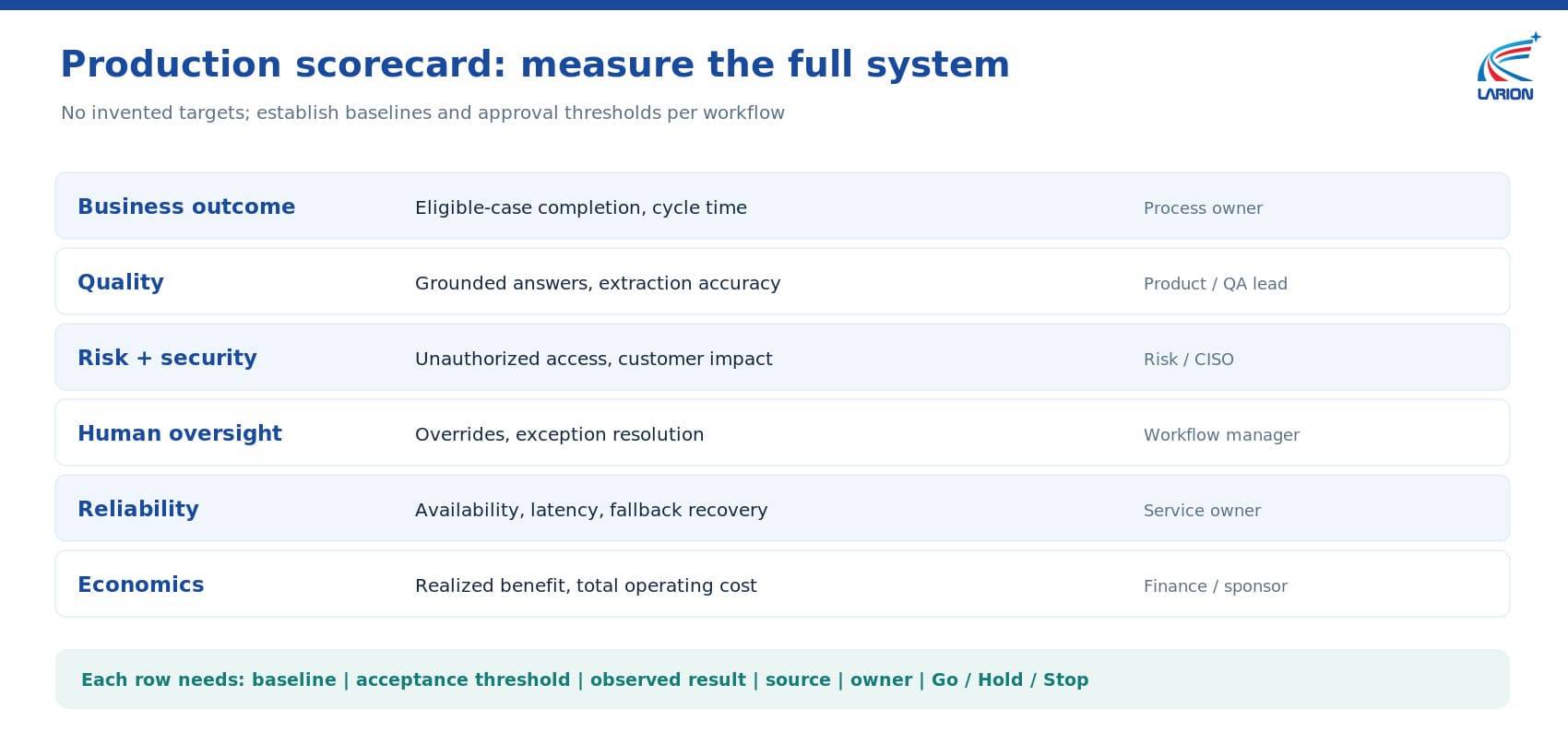
AI transformation financial services – Production scorecard
Example planning cadence not a universal timeline
Initial planning window: Agree on the business charter, data access feasibility, risk classification, and candidate selection. Controlled validation window: Build the smallest approved integration; compare against a non-AI baseline; complete technical and control tests. Operational transition window: Run a bounded pilot, approve or reject live use, and establish monitoring and ownership. These windows may overlap, repeat, or take much longer for sensitive systems, licensing constraints, legacy integration, and high-impact decisions.
When a stage fails, the roadmap should branch. A missing data entitlement sends the project back to readiness. A weak financial case sends it back to prioritization. A control failure blocks release. These are useful decisions not evidence that the program has failed.
Common mistakes that derail financial AI transformation
Starting with a platform purchase. An approved model vendor does not define the business outcome, establish data rights, or own production incidents. Procure against workflow requirements and documented vendor risks.
Calling model accuracy a business result. Offline evaluation cannot show whether staff use the workflow, whether exceptions increase, or whether customer outcomes improve. Measure accepted work and real operating effects.
Treating all AI as one risk category. A read-only knowledge assistant and a system that can change a payment instruction do not require identical authorization and oversight.
Assuming pilot savings will scale. A small test may exclude difficult cases, security requirements, ongoing inference costs, and human review. Recalculate with representative volumes and operating conditions.
Handing responsibility to the technology provider. A vendor may supply tools and evidence, but the institution still needs appropriate internal accountability, oversight, and termination arrangements.
Frequently asked questions
What is the first step in AI transformation for a financial institution?
Select a consequential but clearly defined business workflow, appoint its owner, document today’s performance, and define the acceptable outcome and risk boundary. Tool selection comes after the problem and evidence requirements are understood.
How is a fintech AI transformation roadmap different from a bank’s roadmap?
Both need business ownership, authorized data, evaluation, security, and operating controls. A fintech may have fewer legacy dependencies but stronger reliance on banking partners or other providers. A bank may face larger portfolios of legacy systems, formal supervisory processes, and more complex coordination. The relevant obligations depend on the actual activities, entities, and jurisdictions not the label “fintech” or “bank.”
What should an AI transformation strategy for banking include?
At minimum: a business outcome portfolio, use-case selection criteria, data and system dependencies, risk governance, named decision owners, proof-of-value and pilot gates, production acceptance criteria, and a post-launch measurement loop. It should also document conditions under which AI is not appropriate.
When is an AI pilot ready for production?
When the initiative has met its predefined business and technical acceptance criteria, independent or appropriately separated review has addressed material risks, the production owner can operate and recover the system, and the release authority has accepted a bounded deployment. A successful demo alone is insufficient.
Should banks and fintechs start with generative AI or traditional machine learning?
Start with the workflow. Conventional rules or ML may be better for structured scoring and prediction; generative AI may help with unstructured content and language tasks. In some cases, a standard software integration or process redesign is better than either. Compare alternatives using the same acceptance criteria.
Final recommendation: fund the next verified decision
A financial institution does not need a universal promise that AI will transform everything. It needs an investment sequence in which each step produces evidence for the next. Start with outcomes, confirm readiness, choose the right problem, prove value safely, and deploy only when the institution can govern the resulting service.
If you are designing a roadmap for a bank or fintech, prepare a one-page initiative charter with the workflow, baseline, data dependencies, control boundary, decision owners, and stop conditions before asking a delivery partner for a full implementation proposal.
For implementation support: LARION’s AI Development Services describes capabilities across AI discovery, data foundations, engineering, and deployment. Buyers should validate the applicable project scope, evidence, commercial terms, and operating responsibilities before engaging.
Sources and further reading
- Bank of England and FCA — Artificial intelligence in UK financial services, 2026. Survey context; not a proxy for US adoption.
- World Economic Forum — The AI Playbook for Financial Services, 2026. Strategy, governance, data, workforce and scaling.
- Financial Stability Board — The Financial Stability Implications of Artificial Intelligence, 2024. Sector risks and third-party concentration.
- Federal Reserve — Revised Guidance on Model Risk Management, SR 26-2, April 2026. Current US supervisory guidance with an expressly limited model definition.
- NIST — AI Risk Management Framework Core and Generative AI Profile. Voluntary risk-management resources.
- OCC — Interagency Guidance on Third-Party Relationships: Risk Management, 2023. Third-party relationship lifecycle.