What’s worse than spending months on an MVP that misses the mark? Wasting time on repetitive tasks, slow testing, and endless tweaks.
Nowadays, AI changes the game. It automates routine work, speeds up testing, and delivers real-time insights, helping teams build better MVPs faster, smarter, and with less stress.
Whether you’re exploring AI for startup growth or a large enterprise that uses AI, it means quicker validation, smarter use of developer time, and a stronger chance of achieving product–market fit. Let’s see how AI MVP development process build an MVP faster and more efficient.
What is AI in MVP Development?
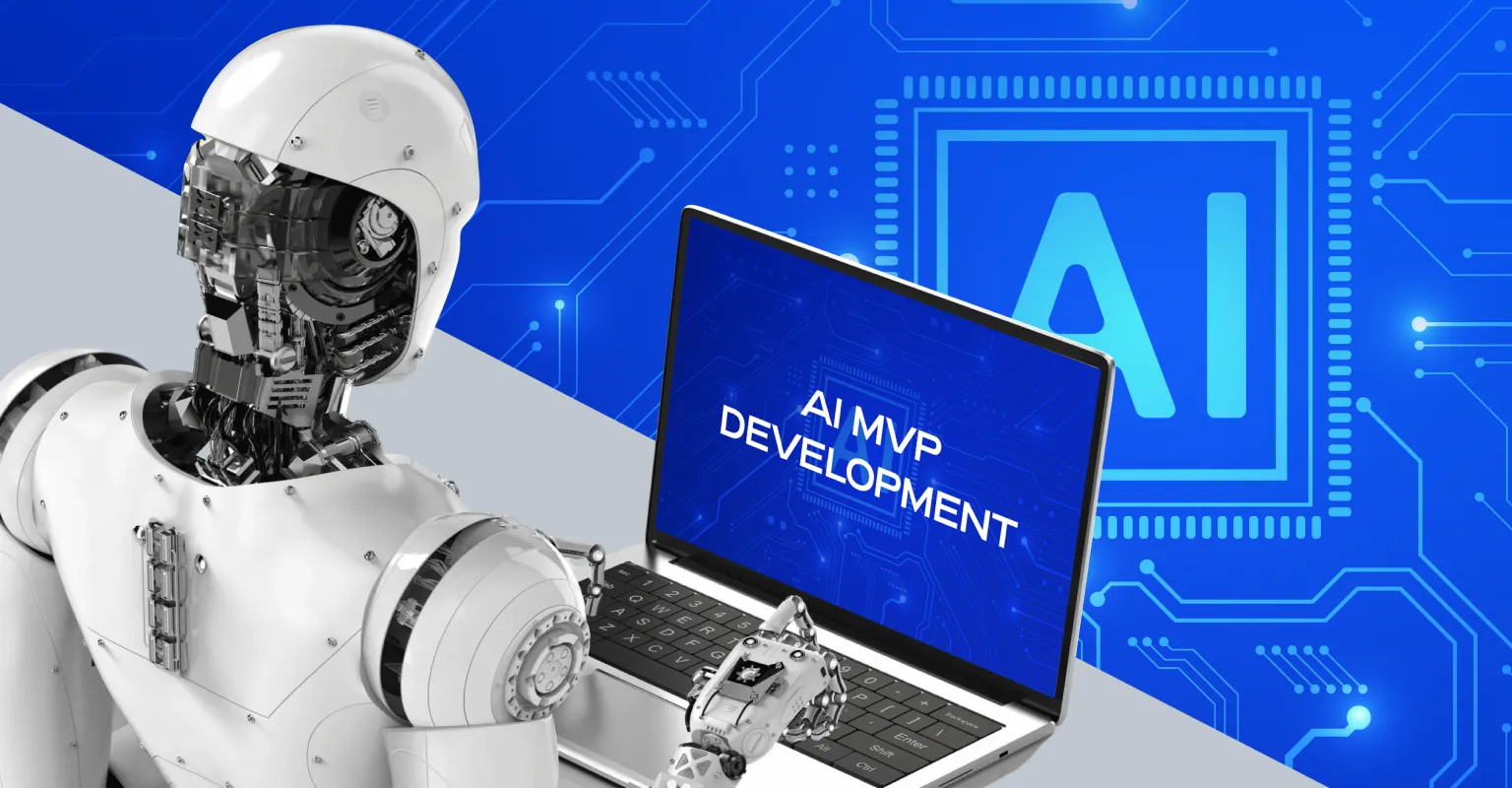
AI in MVP development uses intelligent tools and platforms to perform or significantly assist with tasks traditionally requiring manual human effort. MVP creation employs AI for faster coding, smarter testing, insightful data, and streamlined project management to build prototypes efficiently. It supports teams with powerful copilots and digital assistants to enhance the MVP development process.
Especially for ITO companies, AI MVP development helps maximize delivery speed and cost efficiency while still validating the core business concept. By reducing developers’ workload, effort, and time spent on repetitive tasks, AI allows teams to work smarter, not harder.
These AI systems, which are powered by machine learning and natural language processing, are trained on large datasets, including code, tests, and user interactions. They seamlessly integrate into the software development workflow, automating selected stages where it makes the most sense.
As a result, valuable team members such as developers, product managers, and solution architects can focus on high-impact features instead of routine work. At its core, AI is about amplifying human capabilities and accelerating innovation, not replacing the people behind it.
What Key AI-Driven Product Development for Faster MVPs?
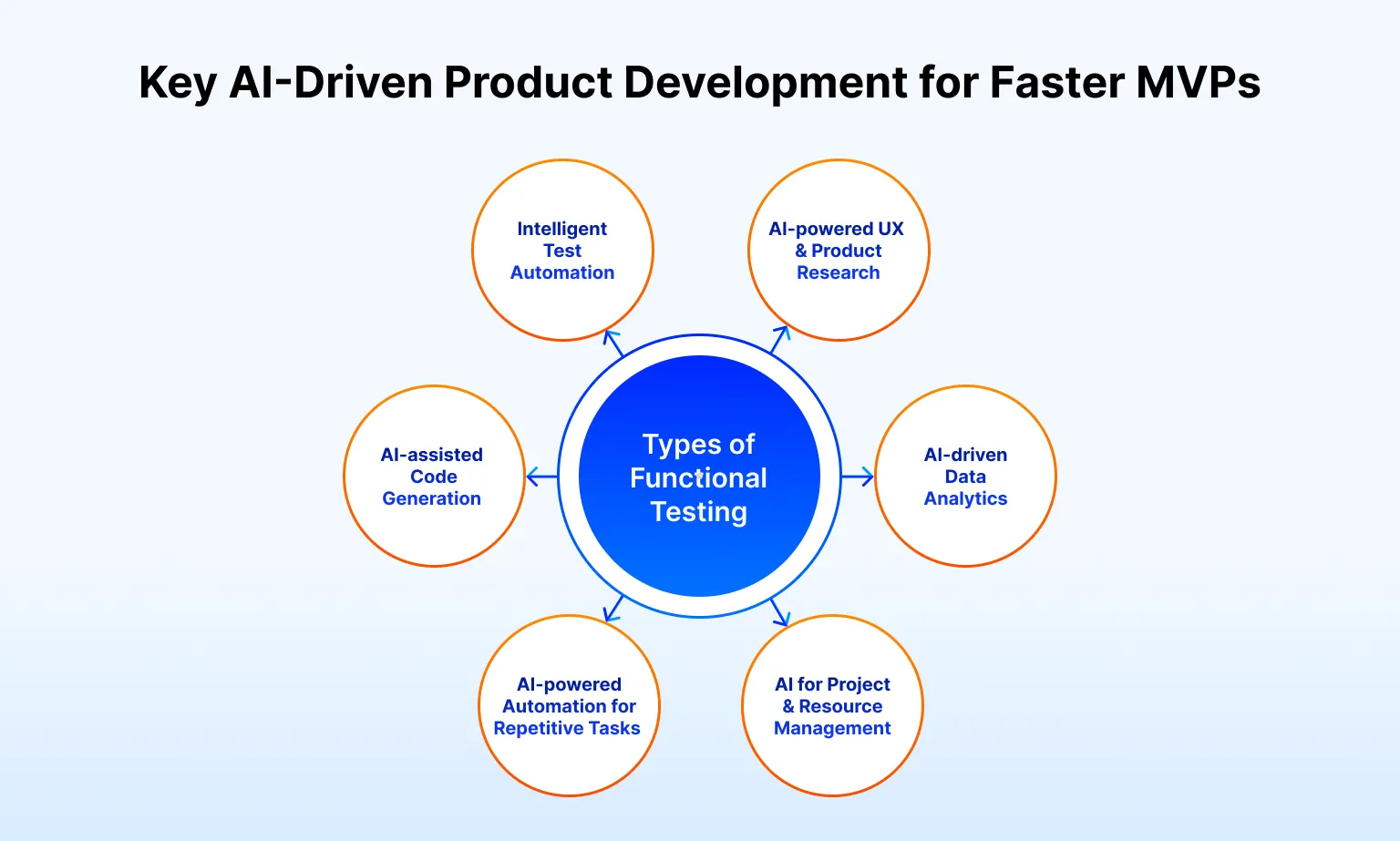
These days, many AI technologies play a key role in accelerating MVP development. Notable examples include AI-assisted code generation, intelligent test automation frameworks, and advanced AI-powered data analytics platforms.
Below are some of the most impactful AI applications in AI-driven MVP development:
| AI Technology Area | Description | Examples & Use Cases | Key Benefit for MVP Speed |
| AI-assisted Code Generation | AI support writing, refactor and source code optimization | Generate CRUD, API endpoints, authentication flow, refactor legacy code |
|
| Intelligent Test Automation | Automation AI to create and optimize test cases and detect soon | Auto-generate unit and integration tests, smart regression testing | Ensure the quality when resealing fast |
| AI-powered UX & Product Research | Analyze the behavior of customers, feedback and data to optimize UX/UI | Heatmap analysis, feedback clustering, A/B testing |
|
| AI-driven Data Analytics | AI analyze the data real-time, find the insight and predict the trends | User behavior analytics, churn prediction, feature usage insights |
|
| AI for Project & Resource Management | AI support estimates efforts and timelines and allocate the resources | Sprint planning, effort estimation, bottleneck detection |
|
| AI-powered Automation for Repetitive Tasks | Automation the daily tasks in dev & operation | Documentation, reporting, CI/CD automation, deployment scripts |
|
How Do AI-Enhanced Timelines Compare in Software Development?
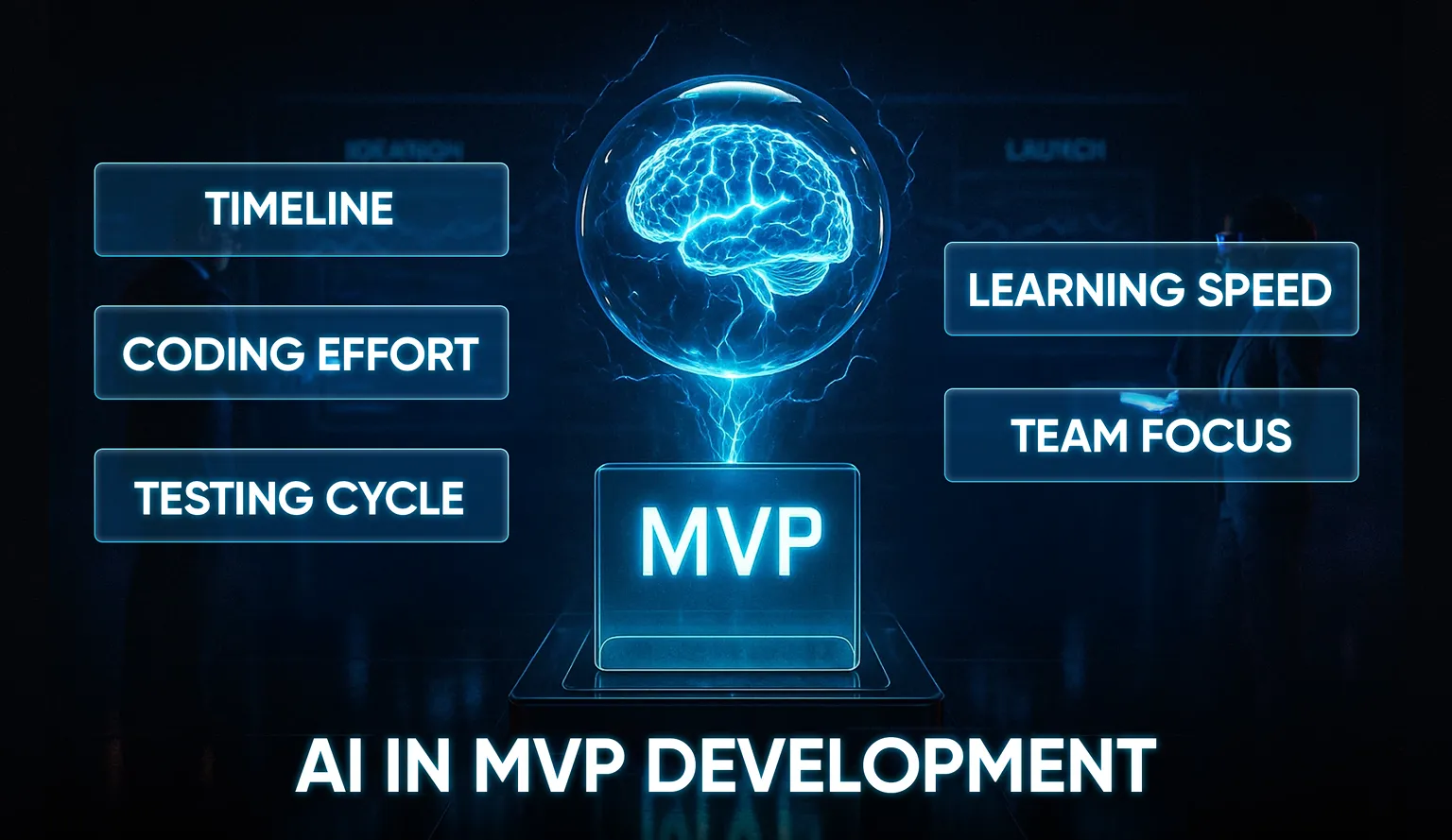
AI-driven development methodologies frequently have permission to implement MVP for only half of the time compared to traditional software development. In practice, the delivery timeline is shortened from 4-6 months to 2-3 months, which makes it more flexible and delivers a significant strategic advantage.
This speed-up represents a major change in how fast software can be built. The comparison below clearly shows the key differences and how they directly affect business results.
The table below highlights the key differences and their direct impact on business outcomes:
| Aspect | Traditional MVP Development | AI MVP Development | Business Advantages |
| Timeline | 4-6+ months | ~ 2-3 months | Faster market validation & shorter path to revenue or funding |
| Coding Effort | Manual creation, requiring significant effort for boilerplate | AI assists in programming, helping to minimize repetitive coding tasks | Cut development costs while using expert developer time more efficiently |
| Testing Cycle | Manual, which leads to longer response times | Fully automated, continuous operation, and rapid response | MVPs offer higher quality, faster bug fixes, and reduced risk |
| Learning Speed | Manual data analysis | AI provides insights in hours | Continuous product improvement at a rapid pace, quickly adapting to market demands |
| Team focus | Repetitive tasks take up a lot of time | Spend more time on innovation and customized logic | Boost product differentiation and customer value |
When integrating AI in MVP projects, the time frame is shortened to support business test ideas quickly, collect crucial market information, and make decisions more correctly about continuous investment or adjust the strategies, significantly de-risking new business software ventures.
Why Should You Use AI Automation for Your Custom Software MVP?
Once your business integrates AI automation into an MVP strategy, it unlocks compelling business outcomes: deploy speedily, save cost, improve the initial quality, and accelerate learning. For bespoke software development, it opens a smarter, more efficient path to validation and achieves a positive ROI. The reason for adopting AI-based development lies not only in the new technology but also fundamentally in executing business more intelligently and creating a competitive advantage.
How Does AI Transform the Software Development Workflow in Practice?
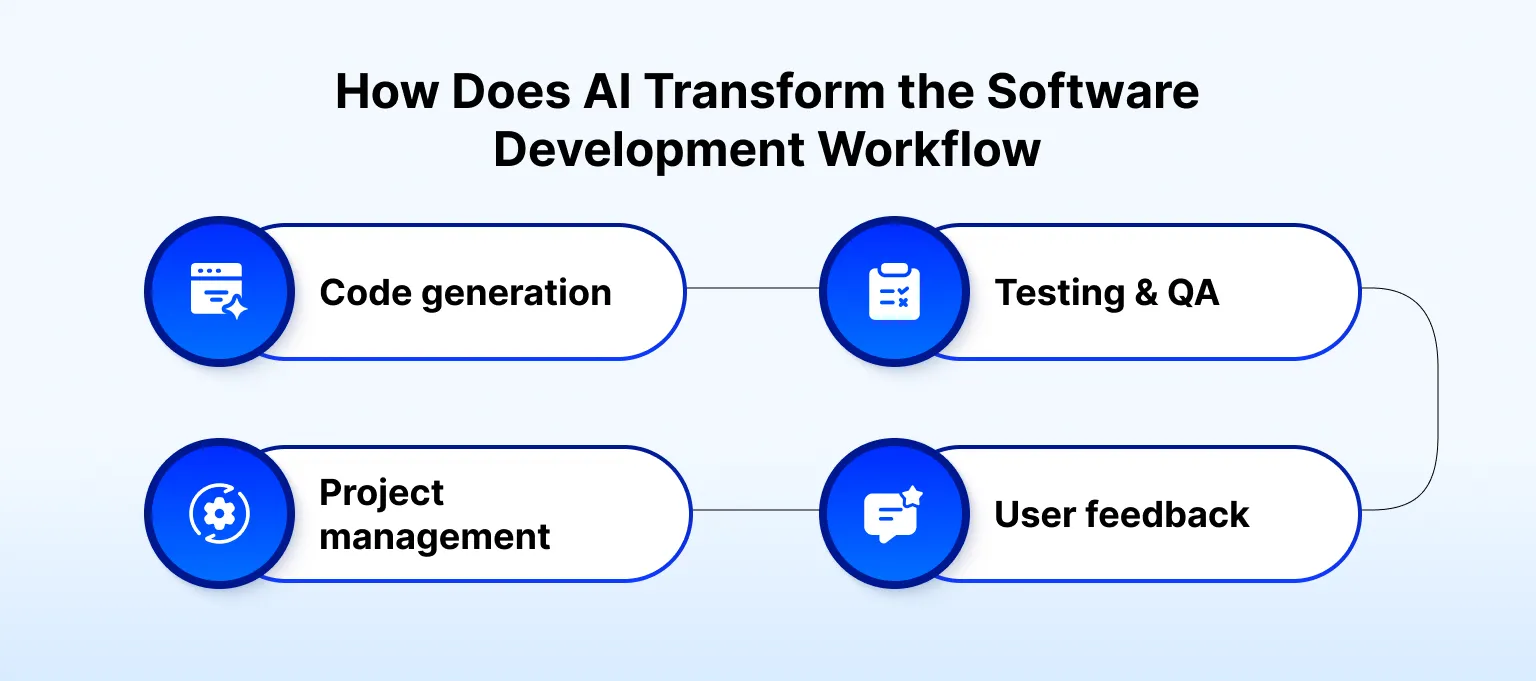
AI is integrated throughout the software development lifecycle, accelerating programming, automating testing, enabling faster data mining, and optimizing project management, thereby enhancing the overall efficiency of custom software MVP projects. This acceleration stems from practical AI applications at critical stages in the MVP building and improvement process.
| Workflow | How AI Accelerates | Impact on Bespoke Software MVP |
| Code generation | Auto-generate boilerplate and smart code suggestions (e.g., GitHub Copilot) reduce routine developer work | Faster setup of core components, with more developer time dedicated to unique, high-value custom logic |
| Testing & QA | Automates and prioritizes testing, enabling continuous, self-healing test cycles | Feedback loops are much shorter, bugs are found earlier, release confidence increases, and QA bottlenecks are reduced |
| User feedback | Uses NLP and ML to quickly analyze feedback and usage data, uncovering trends, sentiment, and key issues | Near real-time user insights enable faster, data-driven pivots and iteration prioritization |
| Project management | Supports predictive scheduling, smart resource allocation, risk detection, and automated reporting (e.g., Jira AI features) | Smoother workflows, less admin effort, early detection of delays, and stronger support for agile delivery |
Through AI-driven optimization at each stage, organizations achieve faster delivery, higher efficiency, and greater flexibility in MVP iteration.
What Challenges Can Businesses Expect from AI MVP Development?
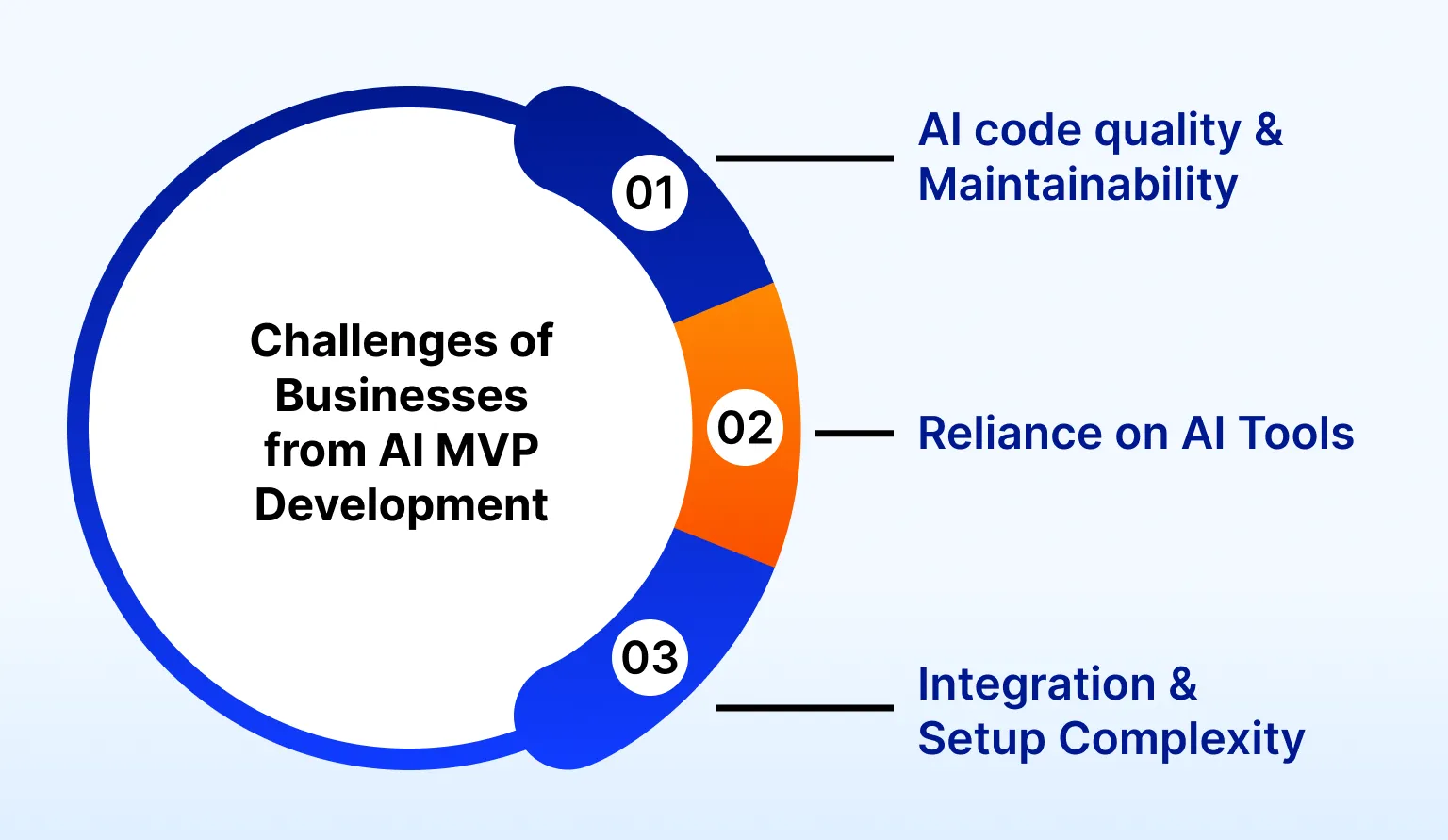
When applying AI MVP development, businesses still face some challenges, such as maintaining high-quality, easy-to-maintain AI-generated code over time, avoiding excessive dependence on AI that could limit creativity or introduce risks, and handling the complexity of integrating AI into existing workflows. To overcome these issues, we need clear planning, strong governance, and consistent human oversight.
Despite its clear benefits, AI MVP development requires leaders to understand these challenges and adopt it thoughtfully to ensure success.
| Challenge Area | Business Risks | Mitigation Strategy |
| AI code quality & Maintainability | Unreviewed or poorly understood AI-generated code leads to technical debt, increasing the cost and difficulty of future updates, scaling, and bug fixes, while reducing bespoke software value | Require strict human code reviews, enforce clear coding standards, prioritize documentation and code clarity, and encourage strong team ownership |
| Reliance on AI Tools | Carrying risks of hidden flaws (security or bugs), possible scalability limits on some platforms and potential erosion of core engineering skills | Set AI boundaries, retain human oversight for critical design, and use AI to accelerate, not replace, work |
| Integration & Setup Complexity | Technical setup takes time, requires team training and workflow adjustments, needs security/compliance checks, and may face compatibility issues | Roll out AI in phases, provide team training and support, ensure tool security and compatibility, and set clear usage policies |
By recognizing these challenges early and applying proactive management, businesses can leverage AI effectively, minimize risks, and ensure AI MVP development truly speeds progress toward strategic goals.
Conclusion
AI MVP development helps businesses launch MVPs faster, reduce costs, and build higher-quality software with less risk. By automating routine work and enabling faster validation, AI has become a strategic must for modern software development, especially for teams looking for MVP development services with an end-to-end process, from ideation to deployment.
In LARION, we help turn this potential into real outcomes. With AI-driven development expertise, we deliver end-to-end AI MVP development services from ideation to deployment, supporting businesses in accelerating MVP delivery, optimizing costs, and building scalable, future-ready products.
Ready to accelerate your MVPs with AI? Contact LARION today for a free consultation.