AI use cases in fintech span customer support, identity verification, financial crime operations, payments, lending and engineering. The hard part is not generating a list. It is deciding which workflow has a problem worth solving, whether AI is the right tool, and what evidence would justify deployment.
A support assistant may be easier to test than an AI credit-decision engine, but it is not automatically the best investment. A payment company overwhelmed by false fraud alerts may have a stronger business case for targeted machine learning. A lender with incomplete decision records may need to fix its data and controls before testing any model.
The right first use case is the one with a measurable outcome, usable data, a viable integration path and controls proportionate to the consequences of being wrong. This guide shows how to compare opportunities, choose the simplest suitable technology and build a business-backed pilot without treating vendor promises as proof.
Key Takeaways
- Start with a failing workflow, not an AI category. Document who does the work, the unit of work, the current bottleneck and the decision that must improve.
- Separate potential value from readiness and risk. A high-value idea can remain unsuitable for an initial pilot if data rights, model validation or operational ownership are unresolved.
- Match the technology to the task. Deterministic rules, conventional machine learning, retrieval-based GenAI and AI agents solve different problems. More autonomy is not inherently more valuable.
- Measure accepted outcomes, including exceptions. Time saved is not realized value unless downstream rework, human review, incidents and run costs are included.
- Make every pilot earn production approval. Set evaluation cases, a business baseline, a named approver, monitoring and a stop condition before building.
What counts as a valuable fintech AI use case?
A useful AI opportunity is a bounded intervention in an existing process. It changes how information is collected, classified, retrieved, assessed or acted on. The buyer should be able to describe the process without mentioning a model.
For example, “deploy a generative AI agent for onboarding” is not yet a use case. “Help analysts extract fields from business-account applications, flag missing evidence and reduce avoidable rework while retaining analyst approval” is specific enough to investigate.
The Bank of England and FCA’s 2026 survey reported AI use among 86% of responding UK financial-services firms. Operations and IT accounted for approximately 31% of reported AI systems. These are observations about participating firms, not a forecast of ROI or evidence that any particular fintech should automate first.
Process bottleneck and decision frequency
Before proposing technology, ask four questions:
- Where does work accumulate? Examples include support queues, document reviews, false-positive fraud investigations and repeated engineering incidents.
- What is the decision or deliverable? An answer with a source, an extracted field, a risk signal, a case summary or a verified code change are different outputs.
- How often does the decision occur? Recurring work may justify integration and ongoing monitoring. Rare but consequential decisions may justify assistance, but not automation.
- What is the cost of an error? Sending an incorrect internal summary is not equivalent to declining a loan, freezing a payment or giving a customer misleading financial information.
Do not equate high transaction volume with high opportunity value. If an existing rules engine completes a routine check cheaply and reliably, adding an LLM may increase cost and error exposure without improving the outcome.
Data availability and control requirements
A promising workflow needs usable inputs, permitted processing and a way to test whether the output is correct. Verify data provenance, freshness, permissions, label quality, history of exceptions and whether the model can access the same information that a reviewer uses.
Also identify who may act on the output. An assistant may draft a response; a trained employee approves a sensitive reply. A model may score a transaction; the payment decision engine enforces approved policy. A document extractor may propose fields; an analyst confirms unresolved mismatches.
First-investment test: If you cannot name the business owner, baseline, data owner, human decision boundary and failure response, the next step is discovery or process cleanup, not a production AI build.
Assess use cases by financial workflow
The following five AI in financial services use cases are organized around business work rather than technology names. Each example is an illustrative operating pattern, not a claim that LARION has delivered the exact workflow to a customer. Each comes with the evidence a fintech team should demand.
Customer support and internal knowledge
Problem: Customers and service agents wait while employees search fragmented product policies, knowledge articles and account procedures. Answers may be inconsistent when information changes.
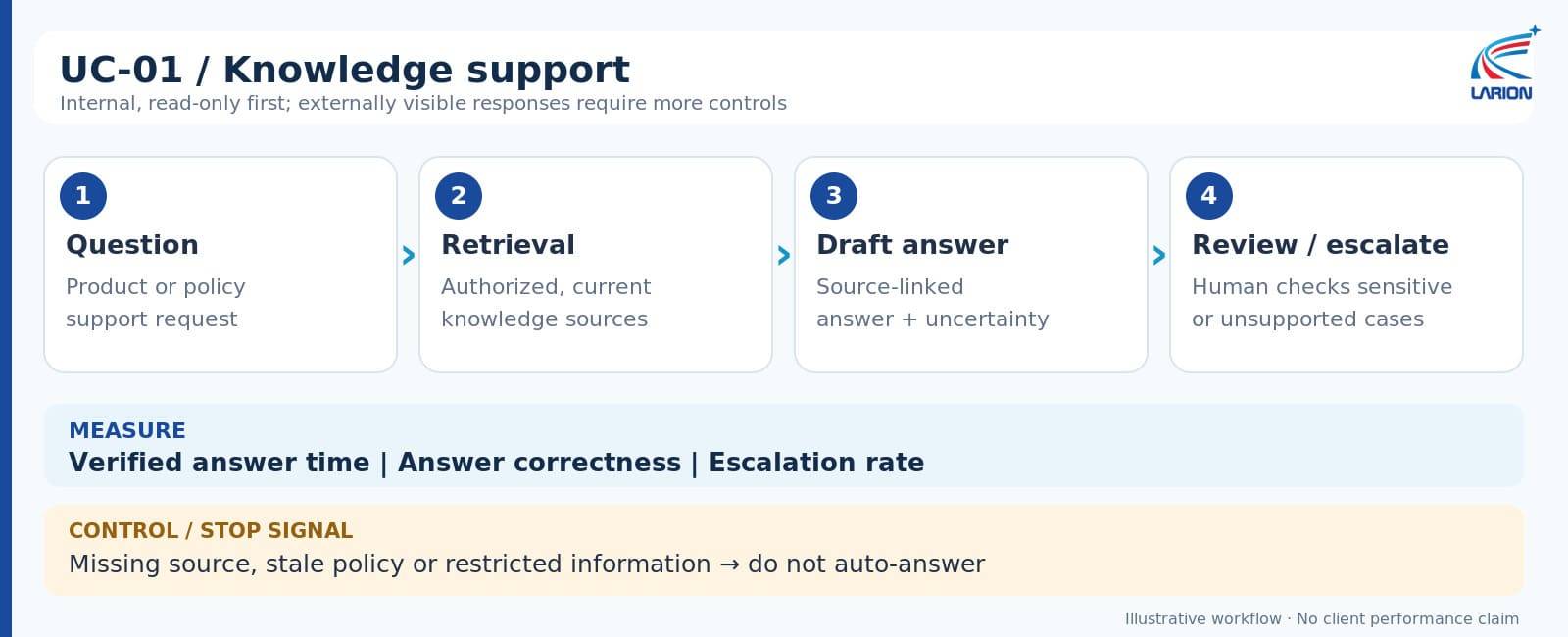
Candidate workflow: A question enters an approved channel → authorized content is retrieved → the assistant proposes a source-linked answer → an employee or controlled publishing rule checks whether the response can be sent → complex or sensitive matters are escalated.
Best initial scope: An internal, read-only support assistant for product and policy questions with a curated knowledge corpus. Broaden to customer-facing answers only after testing permissions, outdated content, unsupported answers and escalation behavior.
| Design question | First-pilot answer to establish |
|---|---|
| AI role | Find relevant policies, summarize or draft answers; do not invent account facts. |
| Inputs | Approved, versioned support knowledge and permission-aware retrieval. |
| Human boundary | Escalation for disputes, advice, account changes and unsupported claims. |
| Primary KPI | Median time to a verified answer, plus answer correctness and escalation rate. |
| Stop condition | Repeated unsupported answers, wrong-document access or unresolved source freshness. |
When not to use AI: If support queries follow a few deterministic paths and the knowledge base is already well structured, improve search, navigation and scripted responses first. An impressive demo is not evidence that a chatbot improves resolved cases.
KYC, AML and document operations
Problem: Analysts repeatedly extract information from identity documents, company registries and supporting evidence, then investigate missing fields or inconsistent records.
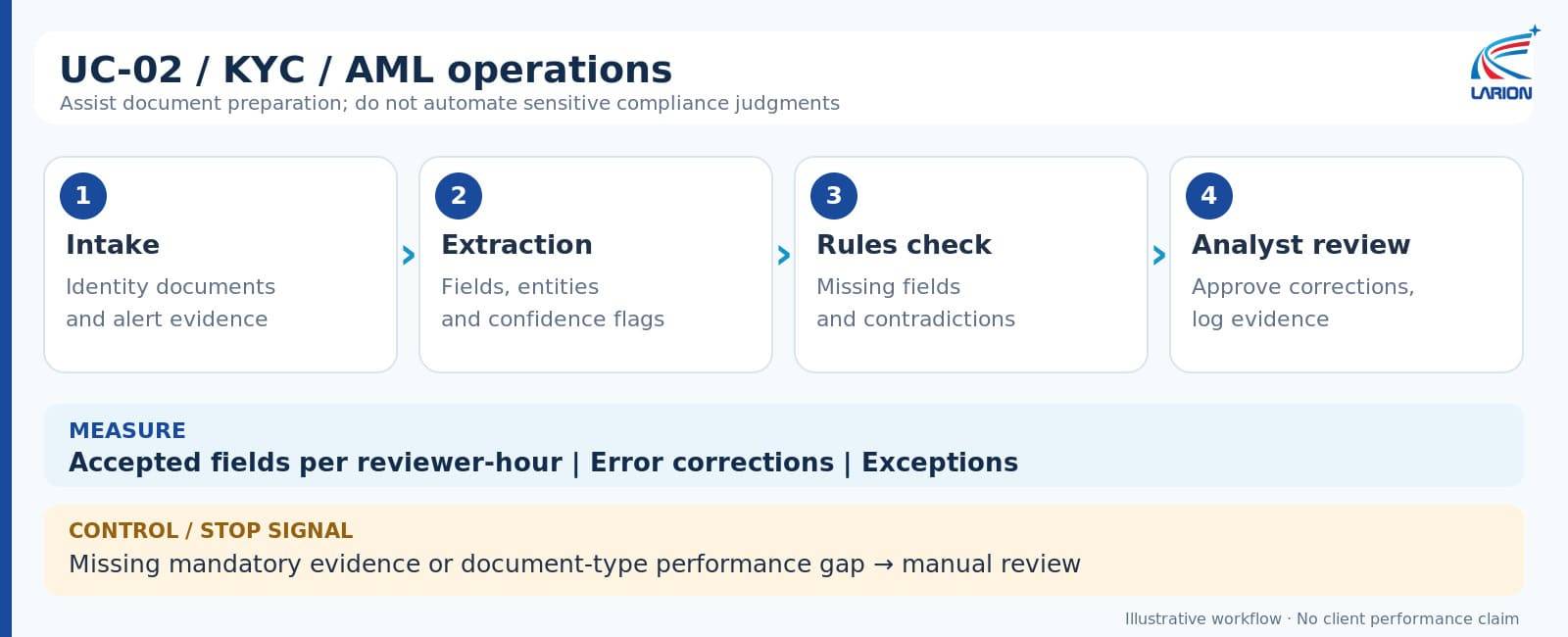
Candidate workflow: Documents and alerts enter an intake queue → OCR/document AI extracts candidate fields → deterministic validation checks formats and rules → an analyst reviews mismatches and risk flags → the system records the reviewed evidence and disposition.
Best initial scope: Field extraction and evidence preparation for a restricted document family. Keep identity acceptance, suspicious-activity judgments and reporting decisions with authorized personnel under applicable policy.
| Design question | First-pilot answer to establish |
|---|---|
| AI role | Extract and classify documents; summarize evidence behind an alert. |
| Inputs | Representative document types, verified labels and permitted identity data. |
| Human boundary | Analysts approve mismatches and any consequential compliance disposition. |
| Primary KPI | Accepted fields per reviewer-hour, corrected error rate and exception backlog. |
| Stop condition | Missing mandatory evidence, untraceable extraction or material error by document subgroup. |
Critical distinction: An AML alert-triage assistant can support an investigation without deciding whether suspicious activity must be reported. The legal and policy obligations remain with the institution and its responsible personnel.
AI use cases in fintech – KYC AML operations
Fraud and payment risk detection
Problem: Payments teams must identify suspicious transactions while avoiding unnecessary declines and overwhelming investigators with false alerts.
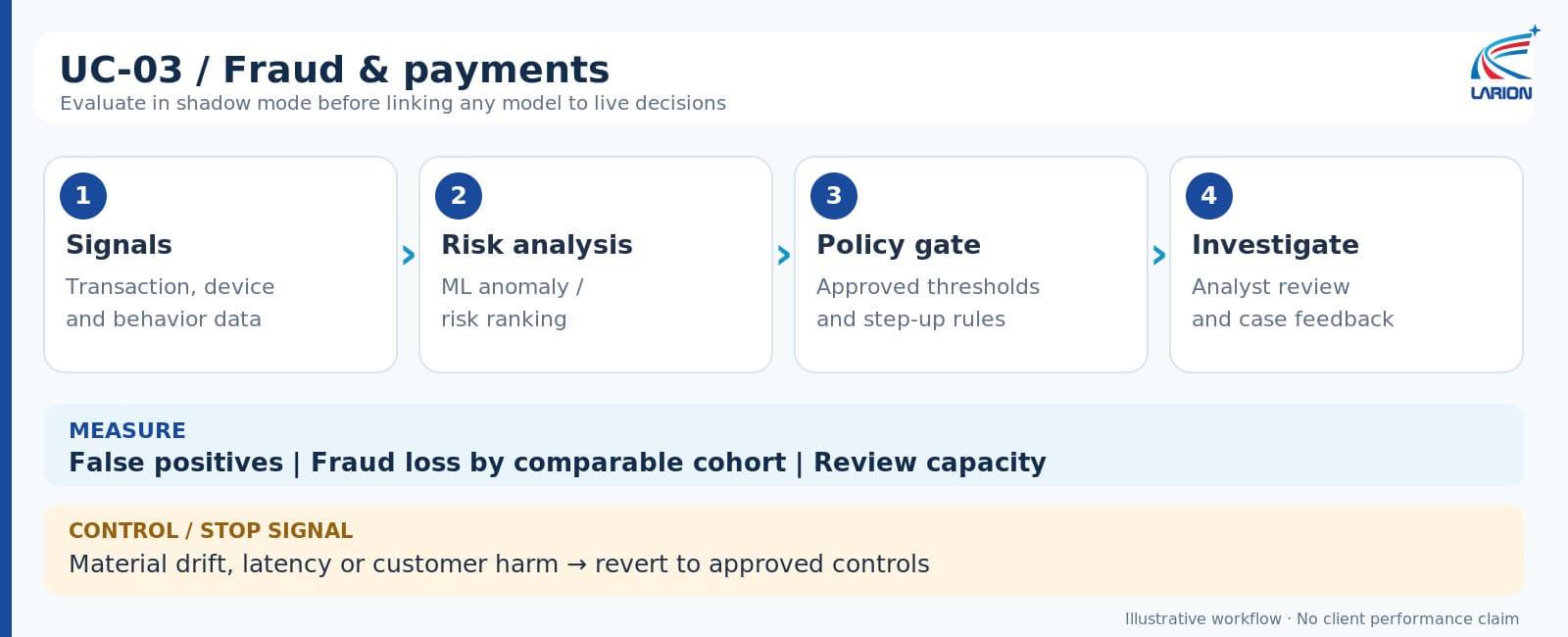
Candidate workflow: Transaction and behavioral signals arrive → an ML model estimates risk or an existing engine identifies an anomalous pattern → policy determines step-up verification, hold or review → investigators adjudicate exceptions → feedback updates evaluation data and rules under change control.
Best initial scope: Analyst prioritization or shadow-mode risk scoring alongside an existing approved payment decision engine. Do not move a new model directly into autonomous payment blocking simply because its offline precision looks promising.
| Design question | First-pilot answer to establish |
|---|---|
| AI role | Risk ranking, anomaly detection or analyst case enrichment. |
| Inputs | Time-ordered events, reliable outcome labels and data-leakage controls. |
| Human boundary | Approved policy governs payment actions; authorized analysts review exceptions. |
| Primary KPI | Investigations per confirmed fraud case, false-positive rate and fraud loss within comparable cohorts. |
| Stop condition | Unacceptable customer friction, drift, latency or a missed-event pattern in critical segments. |
Why this differs from a chatbot: Fraud systems must be tested for class imbalance, delayed labels, adversarial adaptation, latency and customer impact. Faster detection alone is not a complete measure of success.
AI use cases in fintech – Fraud payments
Credit and lending decision support
Problem: Underwriters combine customer records, verification results, credit policies and exceptions across several systems. The evidence trail can be inconsistent or slow to assemble.
Candidate workflow: An application arrives → verified information is assembled → an assistant summarizes policy-relevant evidence or a validated predictive model supplies a risk estimate → an authorized underwriter evaluates the recommendation → the institution records its decision and applicable reasons.
Best initial scope: Document completeness, policy retrieval and underwriting case preparation before considering AI-assisted credit recommendations or automated decisions.
| Design question | First-pilot answer to establish |
|---|---|
| AI role | Prepare an evidence pack or supply a separately validated risk signal. |
| Inputs | Authorized applicant information, policy versions and outcome/label history. |
| Human boundary | Designated decision maker owns approval, denial and adverse-action reasoning. |
| Primary KPI | Complete-case review time, exception rate, accuracy of decision documentation and relevant fairness measures. |
| Stop condition | Unreliable reason codes, subgroup performance gaps, leakage or unexplainable adverse actions. |
For US consumer credit, the CFPB has stated that using complex algorithms does not remove applicable obligations to give specific, accurate reasons for adverse action under ECOA and Regulation B. Requirements depend on the product and jurisdiction; this article is not legal advice.
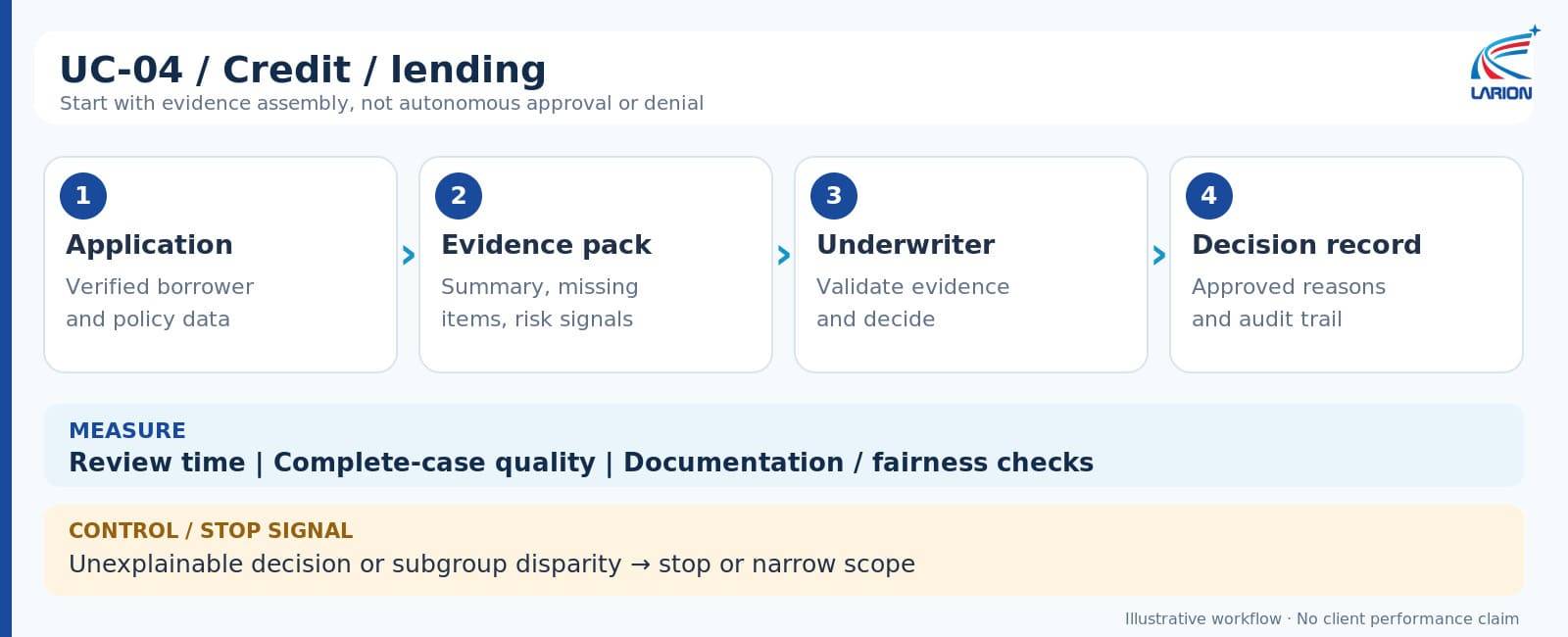
AI use cases in fintech – Credit lending
Software engineering and operations
Problem: Fintech engineering teams lose time reproducing defects, interpreting incident logs, navigating legacy systems and preparing routine changes.
Candidate workflow: Code, tickets or telemetry are collected through approved tooling → AI suggests a root-cause hypothesis, test or code patch → an engineer reviews the change and its security implications → CI/CD checks run → authorized release controls govern production.
Best initial scope: Internal knowledge retrieval, test-case assistance or incident summarization with a reviewable output. Measure the end-to-end delivery result rather than lines of code generated.
| Design question | First-pilot answer to establish |
|---|---|
| AI role | Produce suggestions, tests, summaries or diagnostic leads. |
| Inputs | Authorized repositories, issue history and sanitized incident records. |
| Human boundary | Engineers approve code; production changes require standard release controls. |
| Primary KPI | Accepted change lead time, rework, escaped defects and time to restore service. |
| Stop condition | Sensitive code exposure, insecure suggestions or increased post-release defects. |
Important: A coding assistant that speeds up first drafts but creates extra security review and maintenance work has not demonstrated a positive business outcome.
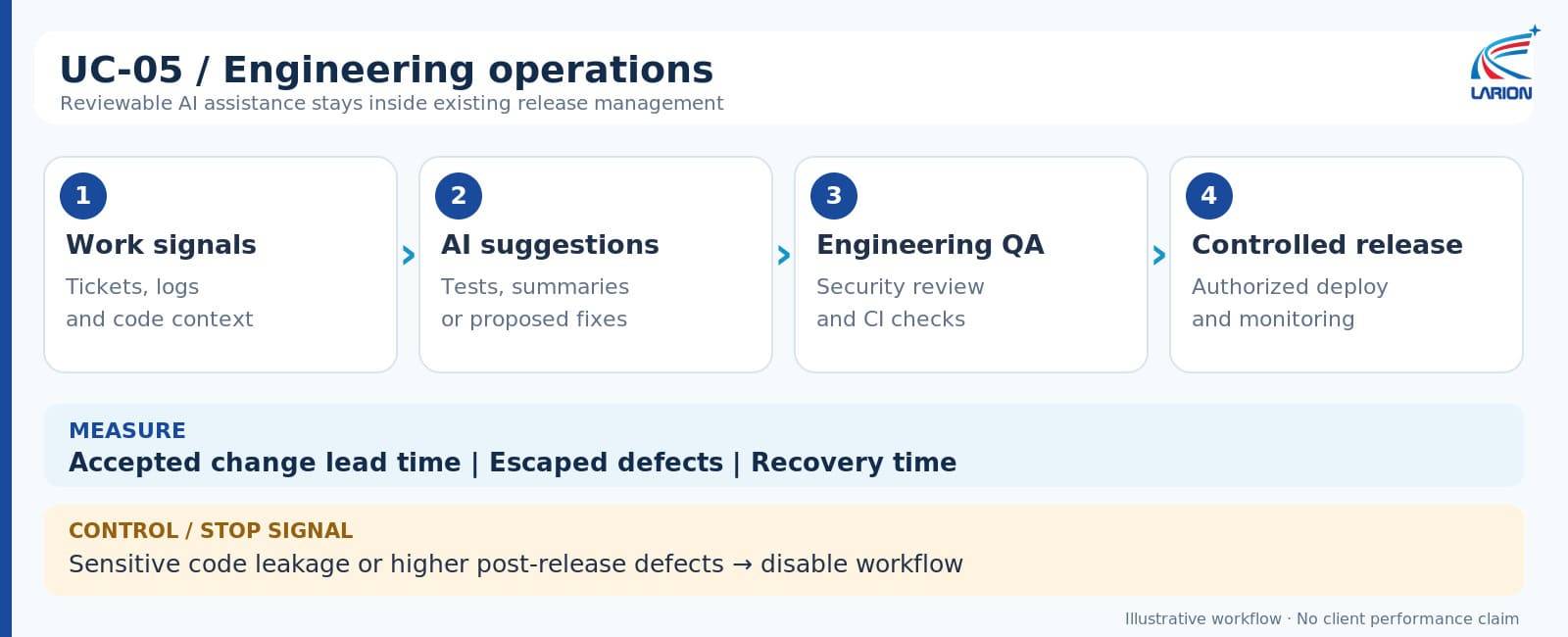
AI use cases in fintech – Engineering operations
Compare the implementation choices
A fintech team should choose the least complex solution that reliably achieves the business outcome. AI does not need to be the answer to every workflow problem.
Rules, conventional ML, GenAI and agents
| Approach | Suitable task | Common failure mode | Sensible first control |
|---|---|---|---|
| Deterministic rules / workflow automation | Known policies, required-field checks, repeatable routing | Brittle rules and unmanaged exceptions | Test coverage, versioning and explicit ownership |
| Conventional ML | Forecasting, ranking, anomaly detection and risk scoring with suitable labels | Drift, biased data, poor calibration or target leakage | Holdout evaluation, segment testing and monitoring |
| GenAI with retrieval (RAG) | Searching approved knowledge, drafting, summarizing and working with unstructured text | Hallucinations, stale sources, prompt injection and access leakage | Permission-aware retrieval, citations, evals and escalation |
| AI agents with bounded tools | Multi-step investigation or coordination where tool use adds value | Unauthorized actions, cascading errors and difficult recovery | Narrow permissions, deterministic approval gates, logs and kill switch |
Use a rule when the outcome is rule-based. Use ML when a pattern must be estimated. Use GenAI when information must be understood or expressed in language. Use an agent only when controlled multi-step execution is demonstrably necessary. Combining approaches is common; the boundaries matter more than the label.
The 2026 Bank of England/FCA survey illustrates that autonomy is not binary: among respondents to the relevant full survey, 80% reported decision-support AI agents, while only 2% reported agents with broad autonomy. These are respondent-level adoption measures, not a recommended autonomy level for every financial firm.
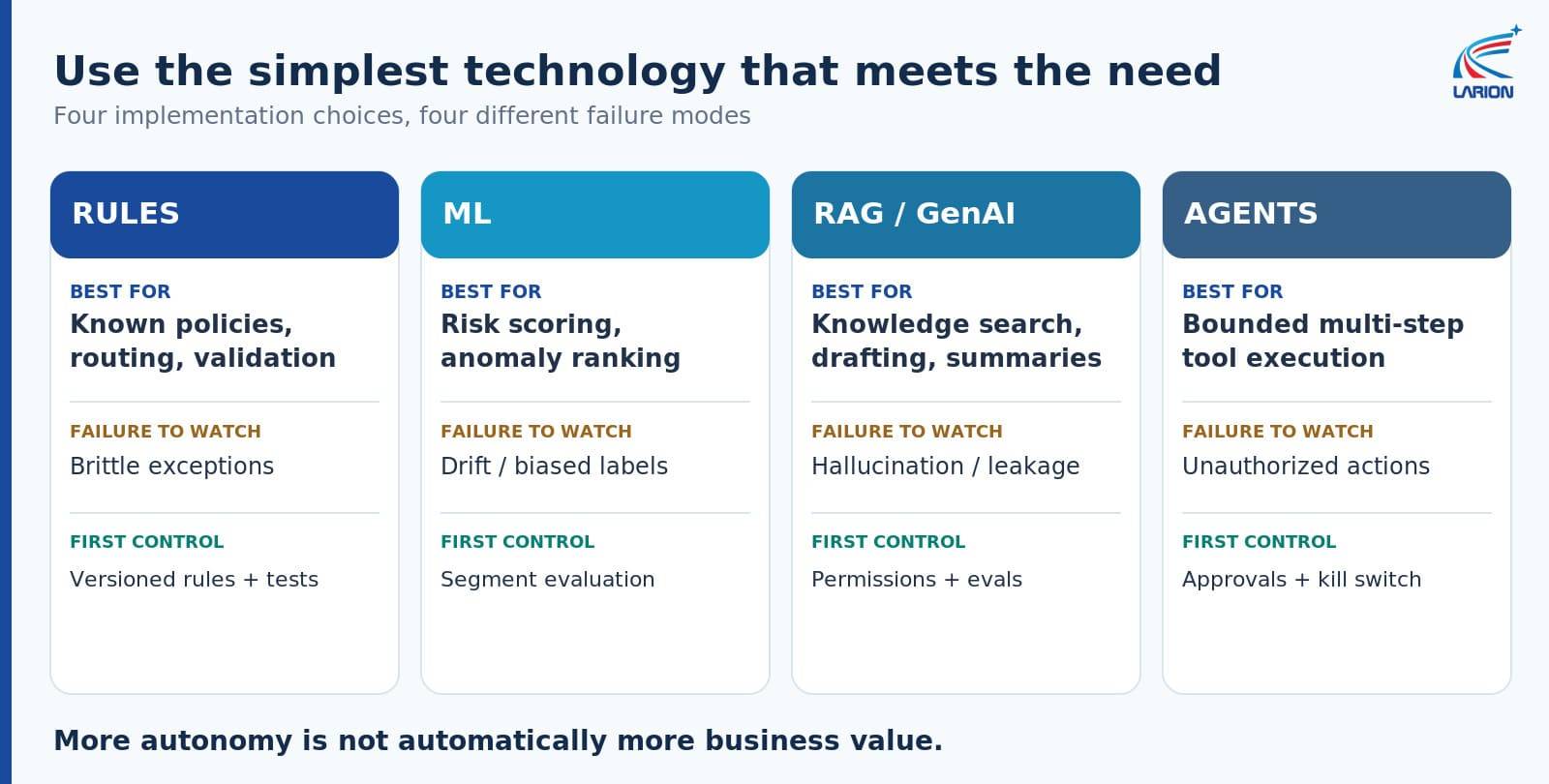
AI use cases in fintech – Technology fit matrix
Build, buy and integration options
Buy or configure when a well-tested vendor product covers a standard task and offers acceptable contracts, data controls, evaluation access and export options. Build when proprietary workflow logic, data access or product differentiation cannot be met by standard tooling and the organization can operate the system. Integrate or customize when an existing model meets the cognitive task but connectors, entitlements, auditability and exception handling determine whether it works in production.
Ask vendors to demonstrate performance on your permitted representative cases, including errors, not only curated examples. Review where data is processed, model-change notices, retention, rights to output, access to logs, exit and incident assistance. Third-party integration does not transfer your accountability for customer outcomes.
Prioritize business value against risk
A ranking that adds a high business-value score to a low-risk score can hide a critical blocker. For banking AI use case prioritization, use two passes: non-negotiable gates first, comparative judgment second.
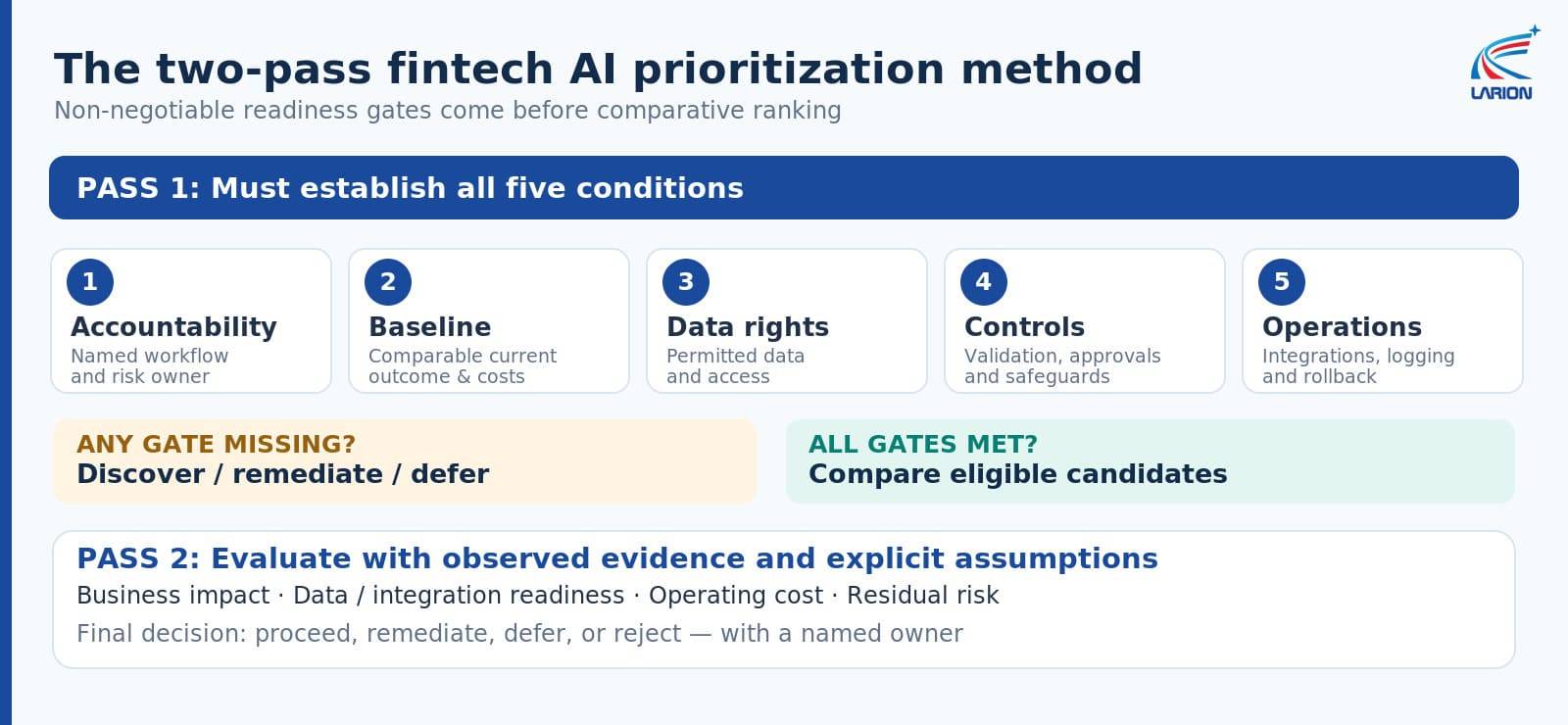
AI use cases in fintech – Prioritization two pass gates
Pass 1: eligibility gates. Do not place a candidate into a production pilot unless you can establish (a) a named accountable owner, (b) a defensible baseline and accepted outcome, (c) lawful and permitted data use, (d) required validation and human/automated controls, and (e) a feasible route to integration, monitoring and rollback. A missing gate means discover, remediate or defer; it cannot be offset by a high opportunity score.
Pass 2: comparable evidence. For eligible candidates, review business impact, process frequency, quality of evidence, data readiness, delivery dependency, ongoing cost and residual risk. Use High / Medium / Low with short written justifications and mark each judgment Observed, Estimated or Unverified. Avoid manufacturing precise weights when those weights have not been agreed with the business.
| Candidate (illustrative only) | Potential value | Typical readiness question | Consequence of error | Reasonable first experiment |
|---|---|---|---|---|
| Internal policy assistant | Reduced knowledge-search effort | Are sources current and permissioned? | Incorrect guidance or leakage | Read-only retrieval evaluation |
| KYC document extraction | Less manual preparation and rework | Are documents labeled across exception types? | Incorrect identity/evidence handling | Analyst-reviewed extraction |
| Fraud alert prioritization | More effective investigation allocation | Are labels and loss outcomes reliable? | Losses or customer friction | Shadow scoring and segment checks |
| Credit case preparation | More consistent evidence assembly | Can reasons, policies and overrides be traced? | Unfair or noncompliant lending outcomes | Document support, no auto-decisions |
| Incident assistant | Faster diagnosis and knowledge reuse | Are logs safe and incident records consistent? | Faulty fixes or data exposure | Read-only summary and engineer review |
This is a decision template, not a universal ranking and not evidence that any candidate outperforms another. In one company, fraud investigation may dominate; in another, improving KYC document quality may remove the greatest bottleneck without touching live decisioning.
Baseline KPI and measurable benefits
Define the unit of analysis before beginning. For example, an AML analyst case, a verified customer answer, a reviewed underwriting file or an accepted software change. Compare like with like by controlling for case complexity and volume changes.
A minimal benefit model is:
Verified net benefit = measurable avoided cost or realized incremental value − additional AI operating cost − human review/rework cost − other attributable implementation and risk costs.
Record the baseline period, cohort definition, data source and how you will compare pilot and business-as-usual results. If the business cannot convert time saved into lower cost, added capacity or improved service, label it capacity released, not booked financial savings. If fraud loss changes while transaction mix and external threats also change, do not automatically attribute the full difference to the model.
Track a balanced set of measures:
- Business outcome: cost per accepted case, genuine fraud loss, resolution quality, supported throughput or validated revenue lift.
- Quality: human correction rate, false positives/negatives, grounded answer accuracy, fairness or critical error rate as relevant.
- Operating effort: human review, exception handling, incident volume, model/cloud spend and maintenance time.
- Control effectiveness: unauthorized access events, missing audit evidence, monitoring coverage, escalation and rollback performance.
Model error, compliance and human oversight
The question is not simply “How accurate is the model?” It is which errors occur, who is harmed, which controls catch them and how the business recovers. Low average error may conceal an unacceptable failure in a sensitive customer segment or rare high-impact transaction.
Before release, document the model’s permitted action space, input restrictions, evaluation data, approval authority, data retention, incident escalation, model-change process and rollback owner. In addition to relevant local rules, NIST’s voluntary AI Risk Management Framework provides a cross-sector basis for mapping, measuring and managing AI risks; its GenAI Profile discusses risks distinctive to generative systems.
A practical no-go rule: If a model can take a consequential customer or money-movement action but the institution cannot explain, constrain, audit and reverse that action where applicable, reduce autonomy or defer the use case.
Documented real-world examples and source limitations
The two cases below demonstrate different types of implementation. They are third-party examples, not LARION client projects, and public accounts should not be confused with independently audited ROI studies.
Morgan Stanley: internal advisor knowledge and evaluation. OpenAI’s published account describes AI @ Morgan Stanley Assistant, which helps wealth-management advisors find information in an internal knowledge base, and Debrief, which prepares meeting summaries and follow-ups for advisor review. The account describes evaluations, regression testing and human oversight; it also reports adoption above 98% of advisor teams. This is a vendor-published customer story, not independent proof of cost savings or suitability for every bank. The transferable lesson is to define representative tests and human review before expanding access.
Commonwealth Bank of Australia: emerging fraud-pattern defense. In an April 2026 announcement, CommBank described an AI agent designed to identify emerging fraud/scam patterns in payment and transaction signals and propose detection rules. The bank describes the function as part of a broader fraud-protection system. The public announcement does not provide a controlled study proving incremental fraud-loss reduction attributable solely to this agent. The transferable lesson is that detection, rule proposal, rule authorization and transaction enforcement should be treated as distinct operational responsibilities.
What these examples cannot tell you: They do not establish a common ROI benchmark, a required model architecture, universal deployment time or a reliable ranking between knowledge retrieval and fraud defense. Use them as evidence of deployment patterns, then test your own case.
Use-case prioritization worksheet
Use this compact worksheet for each proposed project. It is designed to support a go/no-go discussion between Product/Operations, Engineering, Risk/Compliance and Finance—not to generate a decorative score.
| Field | Record one evidence-backed answer |
|---|---|
| Workflow and owner | Specific process, system boundary and accountable decision maker |
| Current bottleneck | Where time, cost, quality or risk is lost today |
| Unit and baseline | Case/transaction/answer/change; historical period and source |
| Proposed intervention | Rules, ML, RAG, agent or non-AI improvement |
| Data and permissions | Availability, provenance, privacy basis, access and quality |
| Integration | Systems, APIs, operational dependencies and rollout environment |
| Errors and affected parties | Most harmful mistakes, customer consequences and required safeguards |
| Decision boundary | What AI suggests, what software enforces and who approves |
| Acceptance evidence | Quality tests, business KPI, source and independent reviewer |
| Full operating cost | Integration, model usage, review, monitoring, maintenance and change |
| Pilot decision | Proceed / remediate / defer / reject, with owner and rationale |
A worked prioritization example (hypothetical)
Imagine a fintech lender considering (1) a customer support assistant, (2) document extraction for merchant onboarding and (3) automated credit approval. No outcome data has been supplied; these are scenario assumptions, not measured results.
Support assistant: The owner is available, but the policy library is outdated. Decision: remediate knowledge freshness first, then evaluate a read-only internal assistant on representative questions.
Onboarding document extraction: A clear reviewer backlog exists, labeled samples are available and human verification remains mandatory. Decision: proceed with an analyst-reviewed pilot, measuring accepted fields per reviewer-hour and corrections, including difficult document variants.
Automated credit approval: Historical labels exist, but adverse-action explanations and subgroup validation have not been established. Decision: defer automated decisions; consider evidence assembly while Compliance and Model Risk resolve the blockers.
The example does not declare onboarding universally superior. It illustrates why a moderate-complexity, reviewable workflow can be the first defensible investment in this hypothetical set of circumstances.
Pilot-to-production decision record
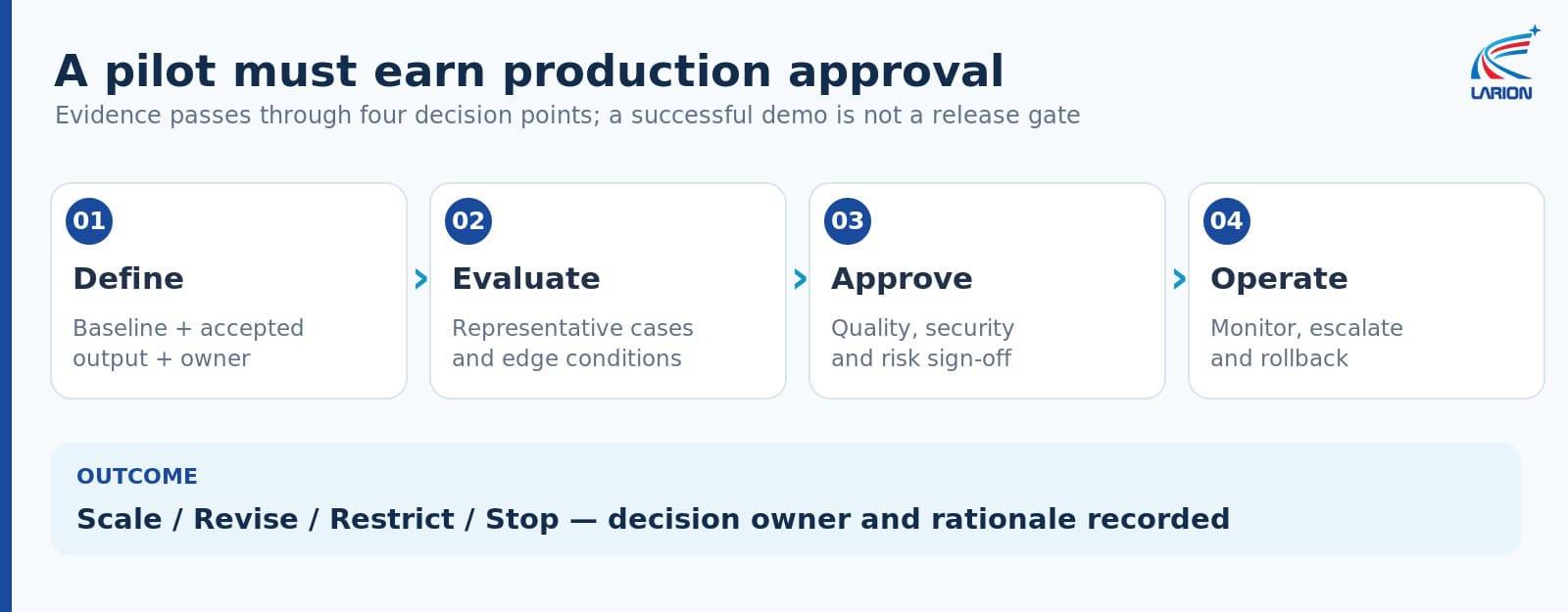
Before authorizing a pilot, record who can approve its scope and data access. During the pilot, compare accepted outputs against the baseline and run adversarial or edge-case evaluations relevant to the workflow. At the release gate, require sign-off from the workflow owner and applicable technical, security and risk stakeholders. After launch, monitor drift, failures, costs, user overrides and the operational ability to switch off or revert the system.
A small pilot should end in one of four decisions: scale, revise, restrict or stop. “The demo worked” is not a production acceptance criterion.
For implementation support, LARION’s AI Development Services and Software Integration Services describe capabilities relevant to discovery, engineering and connecting AI to existing business systems. These pages describe service offerings; they are not evidence that the illustrative use cases in this article were delivered by LARION.
AI use cases in fintech – Pilot to production decision
Frequently Asked Questions
What are the most practical AI use cases in fintech?
Common opportunities include internal knowledge retrieval, document processing, fraud-risk modeling, AML case support, credit-workflow assistance and engineering operations. The practical starting point depends on the institution’s workflow, data, control obligations and measurable baseline—not on a generic top-five ranking.
Which fintech AI use case should a startup build first?
Choose a bounded workflow with a named owner, reliable data, clear manual comparison and limited consequences of error. A startup with a painful onboarding backlog may have a stronger first case for document assistance than for a general customer chatbot. If no candidate passes the readiness gates, improve the underlying workflow before building AI.
Is generative AI better than machine learning for fraud detection?
Not generally. Conventional ML is often suited to structured transaction risk ranking and anomaly detection. GenAI may help investigators summarize complex evidence or search playbooks. They can complement one another, but should be evaluated for separate tasks, latency and risk boundaries.
Can AI approve loans or block payments autonomously?
Technical capability does not establish legal, risk or operational permission. Such actions require jurisdiction- and product-specific analysis, validated decision logic, accountable approvals, customer protections and appropriate audit and recovery controls. Many firms should begin with decision support rather than autonomous execution.
How do you know whether a fintech AI pilot delivered value?
Compare a predefined accepted-work outcome and control metrics against a defensible baseline or comparison group. Include the full cost of infrastructure, human review, exceptions, errors and maintenance. Distinguish observed benefit from estimates, and do not treat released capacity as realized savings automatically.
Final recommendation
Choose the first fintech AI investment by asking what financial workflow must improve, what evidence proves it can improve, and what must remain under human or deterministic control. Shortlist candidate use cases only after identifying the process owner and baseline; eliminate unready candidates through hard gates; then compare the remaining opportunities on business value, feasibility and residual risk. Build the smallest experiment capable of changing a real investment decision.
An effective first AI initiative is not the most autonomous or fashionable. It is the one the organization can test, govern, integrate and operate, with a clear explanation of why the improvement is attributable to the intervention.
Sources and Further Reading
- Bank of England and FCA — Artificial intelligence in UK financial services (26 October 2026). Respondent survey; descriptive evidence, not a universal performance benchmark.
- Stripe — AI in fintech: What it does, where it works, and what to watch for (23 April 2026). Industry context and technical distinctions, not a ranking proof.
- OpenAI — Morgan Stanley uses AI evals to shape the future of financial services. Vendor-published account of a customer implementation.
- CommBank — AI agent spots emerging fraud and helps build defences (April 2026). Bank-published announcement; no independent ROI verification supplied.
- CFPB — Circular 2022-03: Adverse-action notices for decisions based on complex algorithms. US credit compliance guidance; verify current applicability for the specific product.
- NIST — AI Risk Management Framework and Generative AI Profile. Voluntary risk-management guidance.